
Professional Home Theatre Calibration Toronto: Maximizing Your Media Equity
Why are you treating your premium home cinema like a depreciating hobby instead of a stabilized financial asset? Most homeowners believe the heavy lifting ends once the boxes are unpacked, but without professional calibration, you're essentially leaving half of your investment's value on the table. You've likely noticed the issues already; perhaps your open-concept Toronto layout creates inconsistent audio pockets, or your high-end display's colour feels muddy despite the premium price tag. You bought the best hardware because you wanted a world-class experience, yet you're currently settling for factory defaults that don't account for your room's unique acoustics or lighting.
We agree that it's frustrating to see wasted potential in a system that should be flawless. This article will teach you why professional calibration is the mandatory final step for any surround sound system installation Toronto, transforming your hardware into a high-performance asset that delivers studio-accurate results. We'll preview the technical "why" behind room correction, explain how to protect your hardware from premature wear, and show you how to finally achieve the seamless, automated entertainment experience you were promised at the showroom.
Table of Contents
The Factory Setting Tax: Why Your Toronto Home Theatre is Underperforming
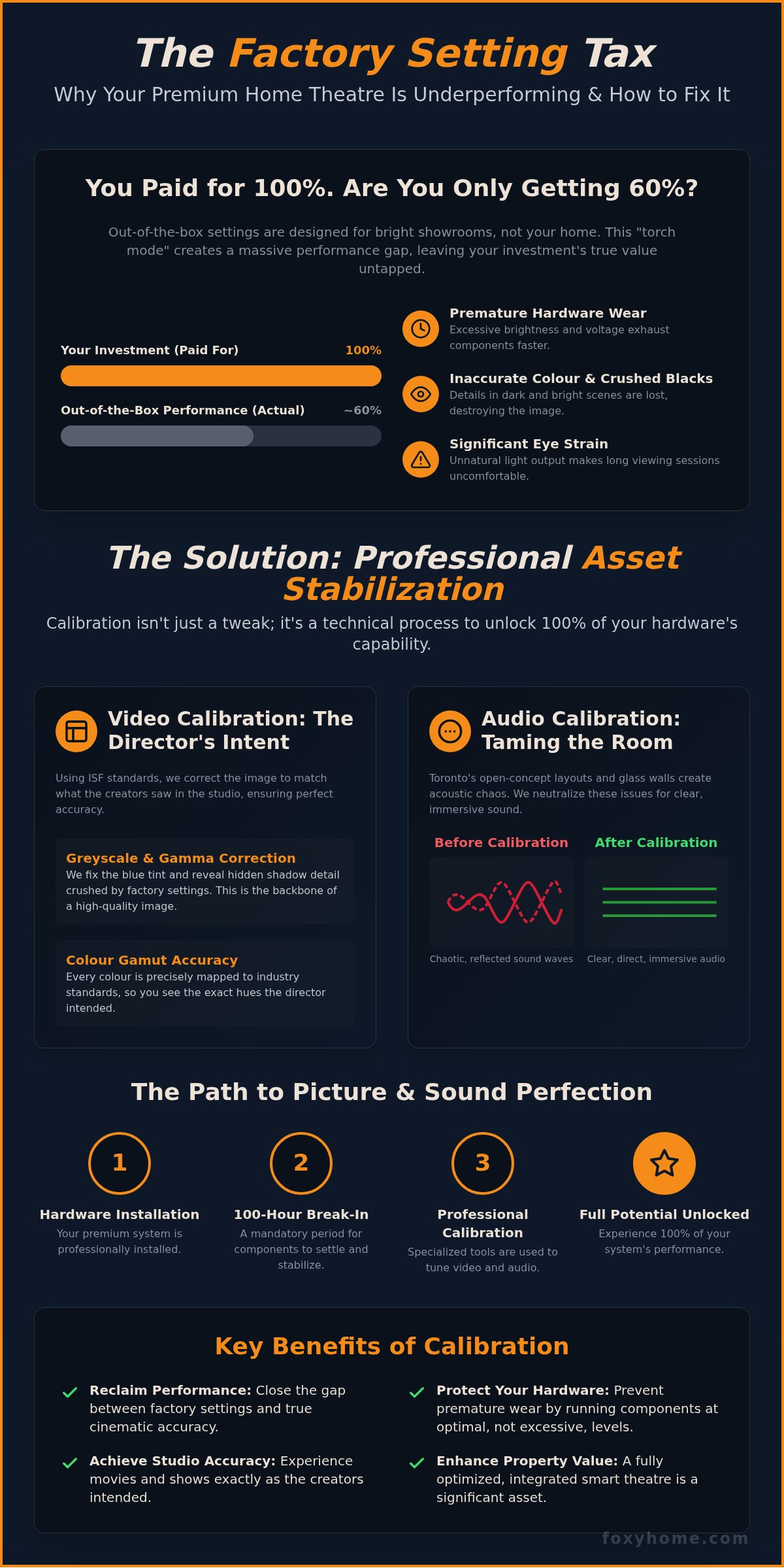
You didn't buy a C$15,000 OLED or a high-end laser projector just to watch it at 60% capacity. Yet, that's exactly what most homeowners do without even realizing it. We call this the "Factory Setting Tax." It's the invisible performance gap between what you paid for and what you're actually seeing and hearing. When you invest in a surround sound system installation Toronto, the hardware is only half the battle. The other half is stabilization. Most systems are essentially "leaking" quality because they haven't been tuned to the specific environment they inhabit.
Manufacturers don't build televisions for your living room; they build them for the bright, fluorescent glare of a big-box retail floor. To compete with the harsh lighting of a warehouse, they crank the brightness and saturation to unnatural levels. This is often called "torch mode." It looks impressive under industrial lights, but in a controlled Toronto home environment, it destroys detail, crushes blacks, and exhausts your hardware. "Out-of-the-box" isn't a badge of convenience; it's a confession of unoptimized performance that disregards the high standards of luxury interior technology.
The Myth of the Cinema Preset
Don't let the menu labels fool you. Pre-loaded "Cinema" or "Vivid" modes are generic guesses made by an engineer in a lab thousands of kilometres away. They don't know about the floor-to-ceiling windows in your Yorkville condo or the specific way your walls reflect surround sound frequencies. These presets are "one-size-fits-none" solutions. There's a massive difference between a display that looks bright and one that looks right. Accuracy isn't subjective; it's a measurable standard that generic presets simply cannot hit because they can't account for your room's unique ambient light and layout.
Hardware Equity: Stop Leaving Performance on the Table
Think of your theatre as a strategic asset. Like a high-performance vehicle, it requires tuning to maintain its value and utility. If you aren't calibrating, you're essentially paying a premium for features you'll never actually use. Professional calibration is the only way to unlock 100% of your purchase. It protects your hardware equity by ensuring components aren't overworked by excessive voltage or heat caused by aggressive factory settings. When planning your surround sound system installation Toronto, remember that the psychological cost of knowing your system is underperforming is just as real as the financial one. Don't let your media room become a collection of expensive, underperforming boxes.
Video and Audio Calibration: The Technical Specs of Asset Stabilization
Calibration is the technical process of neutralizing the variables that degrade your media experience. Think of it as asset stabilization. You've already spent the capital on high-end hardware; calibration ensures those components actually perform to their engineering specifications. In the high-density residential market of the GTA, where glass walls and open-concept layouts are the norm, your environment is actively working against your technology. Professional ISF (Imaging Science Foundation) standards provide the objective benchmark needed to correct these environmental distortions and protect your visual and auditory investment.
Video Accuracy: Colour, Greyscale, and Gamma
Achieving the "Director's Intent" isn't a marketing buzzword; it's a rigorous adherence to colour mapping and gamut adjustment. Factory settings often lean into a heavy blue tint to appear brighter, but this destroys greyscale tracking, which is the literal backbone of a high-quality 4K HDR image. If your greyscale is off, every colour in the spectrum is tainted. We adjust gamma to reveal the shadow detail that manufacturers often "crush" to make blacks look deeper than they actually are. This precision doesn't just make the image look better; it significantly reduces eye strain during long viewings by aligning the display's output with the natural limits of human perception.
Audio Spatiality: Dolby Atmos in a GTA Context
Toronto architecture presents unique acoustic hurdles. Whether it's a glass-heavy downtown condo or an open-concept basement in Etobicoke, sound waves bounce and collide in ways that ruin immersion. During a surround sound system installation Toronto, we prioritize phase correction to ensure your speakers work in harmony rather than acoustic conflict. If your speakers are out of phase, they effectively cancel each other out, leaving you with a thin, hollow soundstage. We also perform a "subwoofer crawl" and digital bass management, which is essential for Toronto townhomes with shared walls. This ensures you feel the impact of the low end at the "sweet spot" without vibrating your neighbour's dining room table.
Equipment Longevity and Thermal Management
High brightness is the enemy of hardware longevity. By optimizing light output through calibrated settings, we significantly reduce the heat and power consumption of your system. This thermal management is vital for extending the life of your projector lamp or OLED panel. Lowering light output to calibrated standards reduces thermal stress on the organic layers of your panel, effectively preserving pixel health over a five-year horizon. If you want to ensure your system remains a high-performance asset, you should consider how integrated smart home strategies can further protect your hardware through automated climate and lighting control.
DIY vs. Professional Calibration: The Gritty Industry Truth
Let's be blunt: a YouTube tutorial and a "calibration disc" from 2015 won't save your media equity. Many Toronto homeowners fall into the trap of thinking they can "eye-ball" their way to a reference-quality image. Your eyes are among the most unreliable tools in the room. They possess an incredible ability to adapt to incorrect white balances, meaning you'll eventually convince yourself that a sickly green tint is actually a "natural" skin tone. DIY tools are essentially generic guesses that fail to account for the specific panel variance and room acoustics inherent in a high-end surround sound system installation Toronto.
The cost-to-benefit ratio of a one-time professional service fee versus purchasing your own gear is massive. To do this right, you'd need to invest thousands in specialized hardware that you'll likely use once every three years. Professional calibration isn't just about moving sliders in a basic menu; it's about the insider knowledge required to navigate hidden manufacturer service menus that are intentionally locked away from consumers. We're here to bridge the gap between "out-of-the-box" mediocrity and the high-performance reality your hardware is capable of achieving.
The Pro Toolset: Spectroradiometers and Signal Generators
Professional technicians don't show up with consumer-grade toys. They use industrial-grade spectroradiometers and bit-perfect signal generators. A Klein or Minolta probe costing upwards of C$20,000 provides a level of precision that a C$200 retail sensor simply cannot match. When paired with software like Calman or ColourSpace, these tools perform a surgical audit of your system. You aren't just getting a "better" picture; you're receiving a verifiable report of your system’s before and after performance data. This data is the proof that your asset has been stabilized to studio standards.
The Risk of the DIY Service Menu
Then there's the service menu, the hidden back-end where the real stabilization happens. One wrong click in these manufacturer-only areas can brick a C$10,000 OLED panel instantly, turning your investment into a very expensive paperweight. A battle-hardened technician knows the specific quirks of the hardware common in Toronto’s luxury market. They navigate these pitfalls so you don't have to. Settling for "good enough" through a DIY attempt is the quickest way to erode your net worth and media equity. If you've already committed to a professional surround sound system installation Toronto, why would you sabotage the final 10% with amateur guesswork?
What to Expect: The Professional Calibration Process in the GTA
Professional asset stabilization is a surgical process, not a "set and forget" task. When we arrive at your property, we don't just start pushing buttons. We begin by respecting the physics of your hardware. If you've recently completed a new surround sound system installation Toronto, you must adhere to the 100-hour break-in rule. Electronic components and speaker drivers need time to settle into their operational state. Calibrating a brand-new panel or projector is a waste of capital; the results will drift within weeks as the hardware matures. We wait until your system is stable so our adjustments remain accurate for years, not days.
The Initial Audit and Light Measurement
We start by measuring your "black floor." This is the absolute minimum light level your room can achieve. In a glass-heavy high-rise condo with ambient city glow, this is your primary friction point. We identify every weak link in your signal chain, from sub-par HDMI cables to misconfigured receivers that might be bottlenecking your bandwidth. By setting this baseline, we account for your room's specific reality rather than a manufacturer's lab fantasy. This audit ensures we aren't just masking problems but actually resolving them at the source.
The Audio Sweep and Acoustic Tuning
Next, we run frequency sweeps to hunt down room resonances. Those annoying rattles in your GTA basement or the hollow echoes in your open-concept living area? We find them. We analyze how sound interacts with your furniture and walls to identify "standing waves" that muddy your audio. Whether we utilize Digital Room Correction (DRC) or recommend physical acoustic treatments, the goal is to neutralize environmental interference. This ensures your surround sound system installation Toronto delivers a coherent soundstage regardless of your home's architectural quirks.
The final phase is iterative testing. We dial in the signal chain, measure the output, and refine the settings until the data matches professional standards. Once the technical work is finished, we provide a complete walkthrough. We don't just hand you a remote; we teach you how to trigger these optimized modes effectively. You'll leave the session empowered, knowing exactly how to maintain your media equity. If you're ready to stop guessing and start measuring, book a professional configuration audit to secure your system's performance.
FoxyHome by PCMNow: Integrating Calibration into Your Smart Home Strategy
Calibration isn't a luxury add-on; it's the "last mile" of a professional smart home ecosystem. Most contractors in the GTA will sell you a pile of expensive hardware, perform a basic surround sound system installation Toronto, and then leave you to navigate the complexity alone. That's a failure of service. At FoxyHome by PCMNow, we treat your home theatre as a strategic component of a larger, automated environment. If your theatre isn't communicating with your lighting, climate control, and network backbone, it isn't truly "smart." It's just an isolated, underperforming island of technology that fails to deliver on its financial promise.
High-performance media requires a robust infrastructure. You can't stream high-bitrate 4K content or maintain calibrated audio standards on a weak residential Wi-Fi signal. We build the internal operational systems and robust networking designed to support the massive data loads required for studio-accurate entertainment. This hands-off, seamless experience is designed for busy professionals who demand perfection without the technical headache. We don't just set up speakers; we stabilize your entire digital lifestyle through the FoxyHome by PCMNow proprietary process, ensuring your hardware is protected from the inefficiencies of standard consumer setups.
One-Touch Entertainment: From Chaos to Conviction
Stop playing IT support in your own living room. The transition from a bright "Living Room" environment to a dedicated "Cinema Mode" should happen with a single tap, not a frantic search for four different remotes. We integrate your calibrated video and audio profiles directly into your automation system. This ensures that when you hit play, your shades drop, your lights dim to the correct Kelvin temperature, and your hardware switches to its optimized performance profile. FoxyHome by PCMNow ensures these settings remain locked on the back-end, protecting your media equity from accidental changes or "helpful" guest adjustments that could erode your system's accuracy.
Future-Proofing Your Toronto Asset
Technology doesn't stand still, and neither should your theatre. Over time, electronic components can drift, and new standards like 8K or advanced Atmos codecs will eventually enter the market. Your surround sound system installation Toronto is a living asset that requires occasional check-ups to ensure it hasn't lost its edge. FoxyHome by PCMNow helps you scale your system as your needs evolve, ensuring your property remains at the forefront of modern interior technology. Don't let your investment stagnate while the industry moves forward. It's time to treat your entertainment with the same strategic rigor you apply to the rest of your portfolio. Audit your theatre performance with FoxyHome by PCMNow to ensure you're getting the ROI you already paid for.
Stop Settling for Factory Defaults and Reclaim Your Investment
Why settle for the factory setting tax when you've already paid for premium performance? Your home theatre is a strategic asset, and leaving it unoptimized is equivalent to leaving capital on the table. By neutralizing environmental friction through professional calibration, you transform a collection of hardware into a stabilized media engine. Whether navigating the glass-heavy acoustics of a Toronto condo or the complex layout of a modern basement, a surround sound system installation Toronto reaches its peak only when the data matches the director's intent.
FoxyHome by PCMNow eliminates the friction between high-end hardware and high-performance results. We manage the complexity of networking, lighting integration, and acoustic tuning so you don't have to. It's time to stop treating your cinema like a hobby and start managing it like the high-density asset it is. Stabilize your media assets-Book a professional calibration consultation today with FoxyHome by PCMNow. Reclaim your media equity and experience the radical transparency of a perfectly tuned system. You've earned the right to see and hear exactly what the creators intended.
Frequently Asked Questions
Is professional home theatre calibration really worth the cost?
Professional calibration is the only way to stabilize your media assets and ensure you aren't paying a "performance tax" on expensive hardware. Without it, you're effectively leaving 40% of your system's potential on the table. For anyone investing in a surround sound system installation Toronto, calibration is the final audit that turns a collection of boxes into a high-performance financial asset. It's a one-time fee that protects your net worth and hardware longevity.
How long does a professional video and audio calibration take?
A comprehensive session typically takes between two and four hours per media room. This duration allows for an initial audit of the signal chain, iterative video measurements, and frequency sweeps for audio spatiality. If your Toronto home has complex architectural hurdles like glass walls or open-concept layouts, the process might lean toward the longer end. We don't rush the stabilization of your assets because precision requires repeatable data and careful acoustic tuning.
Can I calibrate my own TV using a YouTube video?
You cannot achieve reference-level accuracy using generic online tutorials. YouTube videos don't have the industrial-grade spectroradiometers or bit-perfect signal generators required to measure your specific panel's variance. Your eyes are naturally adaptive, which makes them unreliable for setting accurate colour or greyscale. Relying on DIY methods for a surround sound system installation Toronto is a gamble that usually results in crushed blacks, muddy audio, and a significant loss of media equity.
Does calibration void my manufacturer warranty?
Professional calibration does not void your manufacturer warranty. We work within the existing firmware and service menus that manufacturers provide for certified technicians. These adjustments are non-destructive and actually improve hardware health by reducing thermal stress. By optimizing voltage and light output, we ensure your components aren't overworked; this can actually prevent the premature wear that often leads to warranty claims in the first place.
How often should I have my home theatre re-calibrated?
We recommend a re-calibration every 18 to 24 months to account for component drift. Electronic parts and display panels change as they age, meaning your "perfect" settings from two years ago may no longer be accurate today. If you upgrade your receiver, add new speakers, or change your room's lighting, you should book an audit immediately. Regular maintenance ensures your system remains optimized for the latest high-bitrate content standards.
Will calibration make my TV look dimmer?
Calibration often makes a display look "dimmer" at first because it removes the artificial blue-tinted "torch mode" used in retail stores. This is actually a sign of success. We align the light output with the natural limits of human perception and the specific ambient light in your Toronto residence. This reduces eye strain, reveals hidden shadow detail, and prevents the "blown-out" look that destroys cinematic immersion and wears down your OLED pixels prematurely.
What is the difference between ISF and THX calibration?
ISF (Imaging Science Foundation) focuses on the science of display physics and colour accuracy, while THX focuses on the entire cinematic experience. ISF provides the technical benchmarks for asset stabilization at the display level. THX standards often encompass the audio chain and room acoustics as well. Both are valuable, but ISF is the industry standard for ensuring your 4K HDR display is actually showing you the director's intent without factory distortion.
Do I need calibration for a brand-new 4K OLED TV?
You absolutely need it, but only after a 100-hour break-in period. New OLED panels are notoriously unstable right out of the box. Their organic layers need time to settle before their performance becomes predictable. Once that break-in window passes, professional calibration corrects the aggressive factory tints and "black crush" that plague even the most expensive 4K displays. It's the mandatory final step for any premium residential media room in the GTA.


Comments