
Upgrade from Google Nest to Integrated Smart Home: The Professional GTA Playbook
Your collection of smart plugs and DIY cameras isn't a strategy; it's a liability waiting for the next Wi-Fi hiccup. Most Toronto property owners start with the basics, but they quickly hit the Nest ceiling where apps don't talk to each other and security is an afterthought. You've likely realized that the DIY approach has a hard limit, especially when you're toggling between ten different apps just to lock the front door or adjust the temperature. It's time to upgrade from Google Nest to integrated smart home architecture that actually adds value to your portfolio. We're stripping away the consumer-grade fluff to focus on hardwired backbones and unified control systems that stay online when it matters.
This playbook reveals how to move beyond simple gadgetry to professional-grade integration that turns your home into a high-functioning, high-equity asset. You'll discover how to kill app fatigue, close security gaps, and finally automate complex scenes across your entire property using a single, reliable interface. We're moving from fragile cloud setups to a battle-hardened system designed for the long haul in the competitive GTA market. By the end of this guide, you'll know exactly how to transform your property from a collection of gadgets into a streamlined, professional-grade environment.
Table of Contents
The "Nest Ceiling": Why Your DIY Smart Home is Stalling
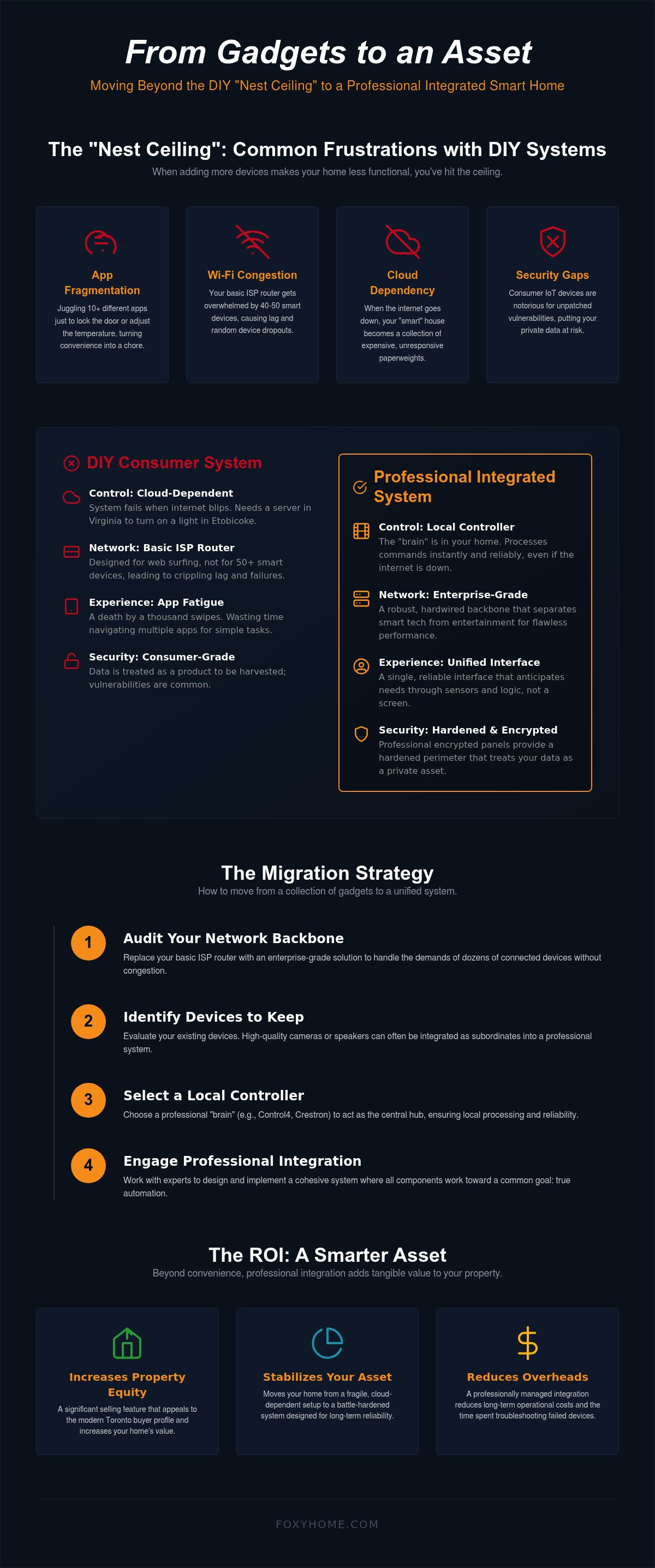
Your Toronto property is a financial engine, but if you're still relying on a drawer full of retail gadgets, you've likely hit the Nest Ceiling. This is the frustrating plateau where adding more devices actually makes your home less functional. What started as a convenient way to check the front door from your phone has evolved into a digital mess of app fragmentation and Wi-Fi congestion. When you decide to upgrade from Google Nest to integrated smart home architecture, you aren't just buying better tech; you're stabilizing a volatile system that currently relies on luck rather than engineering.
The straight truth is that consumer-grade systems are built on cloud dependency. If the internet blips in your neighbourhood, your "smart" house becomes a collection of expensive paperweights. You shouldn't need a signal from a server in Virginia to turn on a light in Etobicoke. Professional home automation prioritizes local control, ensuring your property remains operational regardless of your ISP's uptime. Beyond reliability, there's the glaring issue of security. Consumer IoT devices are notorious for unpatched vulnerabilities, whereas professional encrypted panels provide a hardened perimeter that treats your data as a private asset, not a product to be harvested.
App fatigue is the final nail in the DIY coffin. There's no luxury in opening a smartphone, unlocking it, finding an app, and waiting for it to load just to dim the lights for a movie. That isn't automation; it's a chore. Real integration means your home anticipates your needs through sensors and logic, not through a screen that demands your constant attention.
The Problem with Consumer Wi-Fi
Your ISP-provided router is the weakest link in your Toronto home. These devices are designed for basic web surfing, not for managing the 40 or 50 connections required by a modern smart ecosystem. As you add more sensors and cameras, you create massive interference that kills your streaming speeds and causes devices to drop offline without warning. Network saturation occurs when the volume of simultaneous data requests from dozens of IoT devices exceeds the bandwidth capacity of a standard router, leading to crippling lag and device dropouts. If you want a high-functioning asset, you need a robust, enterprise-grade backbone that separates your smart tech from your Netflix habit.
App Fragmentation and the User Experience
Consider the friction of "smart" living. We've seen clients like Joe and Maria who realized they were losing ten minutes a day just switching between apps to manage climate, lighting, and security. It's a death by a thousand swipes. While voice control is a popular marketing gimmick, it's a backup, not a primary interface for a high-value property. When you upgrade from Google Nest to integrated smart home systems, you replace that digital clutter with a single, unified interface that actually respects your time.
Ecosystem vs. Integration: The Truth About Real Automation
A "connected home" is just a collection of gadgets shouting for attention on your smartphone. Most Toronto homeowners are sold on the idea of an ecosystem, which is really just a marketing term for brand lock-in. When you upgrade from Google Nest to integrated smart home standards, you shift from a retail-dependent hobby to a professional-grade architectural system. The fundamental difference is the "brain." While Google Home lives in a data centre thousands of kilometres away, a professional system uses a local central controller that processes commands instantly without needing an external handshake.
By late 2026, protocols like Matter 1.6 and Thread have certainly smoothed out the wrinkles of device compatibility, with over 4,000 certified devices now on the market. However, a protocol is not a design. Having a common language doesn't mean your devices are working toward a common goal. You can keep your favourite Nest cameras for their AI detection, but they should be subordinates to a professional backbone, not the masters of it. If you want to see how this transition looks in practice, you can explore the integrated smart home solutions that prioritize reliability over retail convenience.
The Hardware Backbone: Beyond the Plug-and-Play
Professional controllers from industry leaders like Control4, Crestron, or Lutron are the new baseline for high-density Toronto properties. These systems don't rely on the "plug-and-play" myth that inevitably leads to device dropouts. Hardwired sensors are the gold standard here. Why trust a battery-powered motion sensor that dies every six months when you can have a low-voltage, hardwired sensor that provides 100% uptime? It's the difference between a toy and a tool for asset stabilization.
Unified Control: One Interface to Rule Them All
Stop scrolling through pages of apps. An integrated home uses dedicated wall-mounted touch panels or engraved keypads that provide immediate access to complex "scenes." This isn't just about aesthetics; it's about removing the friction of daily life. True occupancy sensing means your home realizes you've entered a room and adjusts the climate and lighting based on your habits, all without you ever touching a smartphone screen. This level of automation turns a building into a responsive environment that actually supports your lifestyle and protects your time.
Assessing the ROI of Professional Integration in Toronto
Why treat your Toronto property like a tech experiment when it should be a financial engine? In the high-stakes GTA market, professional integration is the difference between a high-maintenance liability and a stabilized asset. When you upgrade from Google Nest to integrated smart home systems, you're investing in infrastructure that pays dividends in both equity and operational efficiency. DIY gadgets are depreciating consumer electronics; integrated systems are permanent property improvements that savvy appraisers and buyers actually recognize.
Current market data for the Greater Toronto Area shows that homes equipped with integrated security, climate control, and energy management sell 7 to 11 days faster than comparable listings. More importantly, these properties command a price premium ranging from 2.4% to 3.8%. For a detached home in areas like Oakville or North York, that's a significant return on investment that far outweighs the initial cost of professional installation. Beyond the sale price, integrated tech acts as a shield against the rising costs of property ownership in Ontario.
Reducing Operational Overheads
Hydro costs are a constant pressure point for Toronto homeowners. By automating climate and lighting through a centralized system, you can realize energy savings between 15% and 25%. Professional integration allows for sophisticated "setback" schedules that kill utility spikes during peak hours. Additionally, smart leak detection systems integrated into a professional panel can significantly lower your property insurance premiums. Insurers view a hardwired, monitored system as a massive risk reduction, whereas a battery-powered Nest sensor often doesn't even move the needle on your policy.
Tech as a Selling Feature
The "Modern Buyer" in the GTA no longer views smart tech as a luxury; it's a baseline expectation. A home relying solely on a retail Wi-Fi router is viewed as technologically obsolete. Conversely, a property with a Cat6-wired backbone and a professional controller signals to buyers that the home was built or renovated with the future in mind. This infrastructure is particularly vital for the FoxyHome multi-plex conversion strategy. Integrated systems allow for streamlined multi-unit management and precise tenant billing for utilities, turning a standard residential building into a high-functioning income asset. You aren't just buying better lights; you're building a more profitable portfolio.
The Migration Strategy: Moving from Gadgets to a System
Stop treating your home like a science project. If you want to upgrade from Google Nest to integrated smart home standards, you need a surgical approach to migration. This isn't about throwing away every piece of hardware you've bought; it's about reorganizing your tech stack to prioritize reliability over marketing hype. We start with a ruthless network audit. While previous sections highlighted why retail routers fail, the audit phase is where we replace them with enterprise-grade access points that treat connectivity as a permanent utility rather than a lucky signal.
Next, we identify the "keepers." Not every Nest device is a liability. Your Nest Learning Thermostats, for instance, are often worth keeping if they support the Matter protocols rolling out in 2026, allowing them to communicate with a professional controller. However, the "lighting pivot" is non-negotiable. Smart bulbs are for dorm rooms. For a permanent Toronto asset, you replace bulbs with smart switches. This ensures that if a guest flips a physical switch, your automation doesn't break. Finally, we move to professional configuration. You aren't just paying for installation; you're paying for the custom logic that connects your security, climate, and lighting into a single, cohesive workflow.
The Gritty Truth About Wiring
Ethernet remains the gold standard for security and performance in Toronto estates. Wireless is convenient, but it's vulnerable to interference and signal dropouts. Hardwiring your primary cameras and access points with Cat6 cable ensures 100% uptime and eliminates the latency that plagues DIY setups. Don't let the age of your property scare you. Retrofitting older GTA homes is often cleaner than homeowners realize. Professional installers use existing pathways to run discreet lines, providing the backbone your property deserves without damaging your architectural details.
Selecting Your New "Brain"
Choosing a professional platform is about more than just a fancy interface; it's about reclaiming your privacy through local control. You want a system that keeps your data inside your walls and continues to function even if the internet service provider fails. This central processor acts as the translator for your remaining Nest devices, ensuring they play nice with your high-end lighting and security panels. If you're ready to stop playing with gadgets and start building a system, you can get a professional smart home consultation to map out your migration path.
The FoxyHome Approach: Building a Future-Proof Asset
FoxyHome by PCMNow doesn't view smart tech as a vanity project or a collection of cool gadgets. We treat it as a core component of property development and a tool for generational wealth. While the average DIYer is busy resetting their router or troubleshooting a camera that went offline, our clients are focused on asset stabilization and high-density residential structures. When you upgrade from Google Nest to integrated smart home systems with us, you're buying into a "hands-off" promise. We design, install, and configure every sensor, switch, and controller while you focus on the big picture of growing your net worth. It's time to move away from a home that demands your constant attention and toward one that protects your legacy.
Integrating security and automation creates the ultimate protective layer for your property equity. We don't just stop at a doorbell camera; we build systems that scale. Our architecture is designed to grow alongside your portfolio, moving seamlessly from a single-family dwelling into a sophisticated 5-unit multi-plex conversion. This scalability is a rallying cry for urban density in the GTA. By centralizing the management of multiple units into a single interface, you eliminate the operational friction that usually kills multi-unit profitability. We turn the complexity of property management into a streamlined, proprietary process that works for you.
Professional GTA Installation
Toronto’s bureaucracy is a minefield for the unprepared. We know the local building codes and the gritty reality of urban development in the city centre. Because our systems are engineered as part of a larger architectural strategy, we offer a 10-year builder warranty on our work. We stand behind our integrated systems because we've already navigated the high-stress environments of city construction pitfalls for you. This isn't just about installing tech; it's about providing battle-hardened reliability that stands the test of time.
Ready to Stabilize Your Asset?
The transition from a technical liability to a strategic financial asset begins with a single decision. Stop fighting with consumer-grade cloud systems that fail when you need them most. Your property should be a high-functioning tool for wealth, not a source of app fatigue and frustration. If you are ready to upgrade from Google Nest to integrated smart home architecture, the path to a stabilized, future-proof asset is clear. We handle the technical grit so you can enjoy the financial rewards.
Secure Your Legacy with Architectural Intelligence
The DIY era of smart gadgetry is over for the serious Toronto property owner. You've seen how the Nest ceiling creates digital clutter and network instability that can actually devalue your holdings. Real property modernization isn't about adding more plugs. It's about building a robust, hardwired infrastructure that functions as a permanent utility. When you choose to upgrade from Google Nest to integrated smart home architecture, you're moving from a hobbyist's cloud experiment to a battle-hardened system that protects both your data and your equity.
Our professional GTA-based technicians specialize in full system integration across lighting, climate, and security, all supported by enterprise-grade networking solutions. This isn't just about convenience. It's about asset stabilization in a high-density market that demands technical excellence. You don't have to manage the complexity yourself. We handle the grit of configuration so you can enjoy the financial rewards of a high-functioning property.
Turn your home into a high-tech asset—Book your Toronto Smart Home Consultation
Your property is too valuable to leave to a retail router. It's time to build something durable that respects your time and your net worth.
Frequently Asked Questions
Can I still use my Google Nest cameras with a professional integrated system?
Yes, you can integrate your existing Nest cameras, but they'll operate as subordinates to a professional logic engine. When you upgrade from Google Nest to integrated smart home architecture, we often keep high-performing cameras while moving the heavy lifting to a local controller. This allows you to retain your hardware investment while eliminating the latency and cloud-dependency that usually plagues DIY setups. It's about making your hardware work for your system, not the other way around.
How much does it cost to upgrade from a DIY smart home to a professional setup in Toronto?
The cost of a professional setup in the Toronto area depends on your property's scale, but mid-range projects generally range from a few thousand dollars to more comprehensive luxury configurations. You shouldn't view this as a retail purchase. Instead, treat it as a strategic move toward asset stabilization. Integrated tech often yields a price premium of 2.4% to 3.8% in the GTA market, making it a permanent property improvement rather than a depreciating gadget.
Will a professional smart home system work if my internet goes down?
A professional system continues to function locally even if your internet service provider fails. Unlike consumer-grade hubs that rely on a handshake with a remote server, professional controllers process your automation logic inside your home. Your lights will still turn on, your sensors will still trigger, and your security panel will remain active. This local-first approach is the primary reason to upgrade from Google Nest to integrated smart home systems in the high-stakes GTA market.
Is professional smart home installation worth it for a rental property or multi-plex?
Integrated tech is a massive advantage for multi-plex conversions and high-density rentals. It allows for precise utility tracking and automated building management that reduces your operational overhead. By installing professional-grade systems, you attract higher-quality tenants who view smart features as a baseline expectation. This tech isn't a luxury for landlords; it's a strategic tool for stabilizing your income-generating asset and protecting your long-term legacy. It turns a standard building into a high-functioning tool for wealth.
What is the difference between a smart home hub and a professional controller?
A smart home hub is essentially a bridge to the cloud, whereas a professional controller is a local processing powerhouse. Hubs are designed for simple device pairing and often fail when internet speeds drop or cloud servers go offline. Professional controllers manage complex logic, encrypted security protocols, and high-bandwidth networking entirely on-site. This brain ensures your home responds instantly to occupancy and environmental changes without waiting for a signal from a remote data centre.
How long does it take to retrofit an older Toronto home with integrated smart tech?
Most retrofits in older Toronto homes are completed within a few days to a week. The timeline depends on whether we are performing a full network overhaul or simply integrating new control logic into your existing structure. Our technicians are battle-hardened when it comes to navigating the unique architectural challenges of GTA properties. We prioritize a hands-off experience for you, ensuring the configuration is handled efficiently while you focus on your broader investment goals.
Does professional smart home integration require tearing down my walls?
Professional integration rarely requires tearing down walls. We utilize a combination of existing wire pathways, advanced wireless mesh protocols, and smart switches that fit into your current electrical boxes. Even in heritage properties, we can run discreet Cat6 cabling or use low-voltage solutions that maintain the architectural integrity of your home. You get the benefits of a hardwired backbone without the mess of a full-scale construction project or the need for extensive drywall repair.


Comments