
Whole Home Audio System Cost: The 2026 Toronto Homeowner’s Guide
Why are you still letting a "free" app and a spotty Wi-Fi router dictate the atmosphere of your $3 million Toronto home? If you are tired of audio lag killing the vibe or messy wires sabotaging your interior design, you aren't alone. Most GTA homeowners eventually realize that a collection of mismatched smart speakers isn't a system; it is a technical liability. You deserve a setup that adds genuine resale value and operates with a single, effortless tap. This guide delivers the radical transparency you need regarding the whole home audio system cost in 2026. We are stripping away the industry fluff to give you the unfiltered truth about hardware, professional labour, and the critical network backbone that keeps every room in sync. We will break down price-per-zone estimates and explain how to transform your property into a high-performing asset. From hidden installation pitfalls to the luxury of "hands-off" control, here is what it actually takes to wire your home for sound without the typical construction headaches.
Table of Contents
Why Whole Home Audio Is a Property Asset, Not an Expense
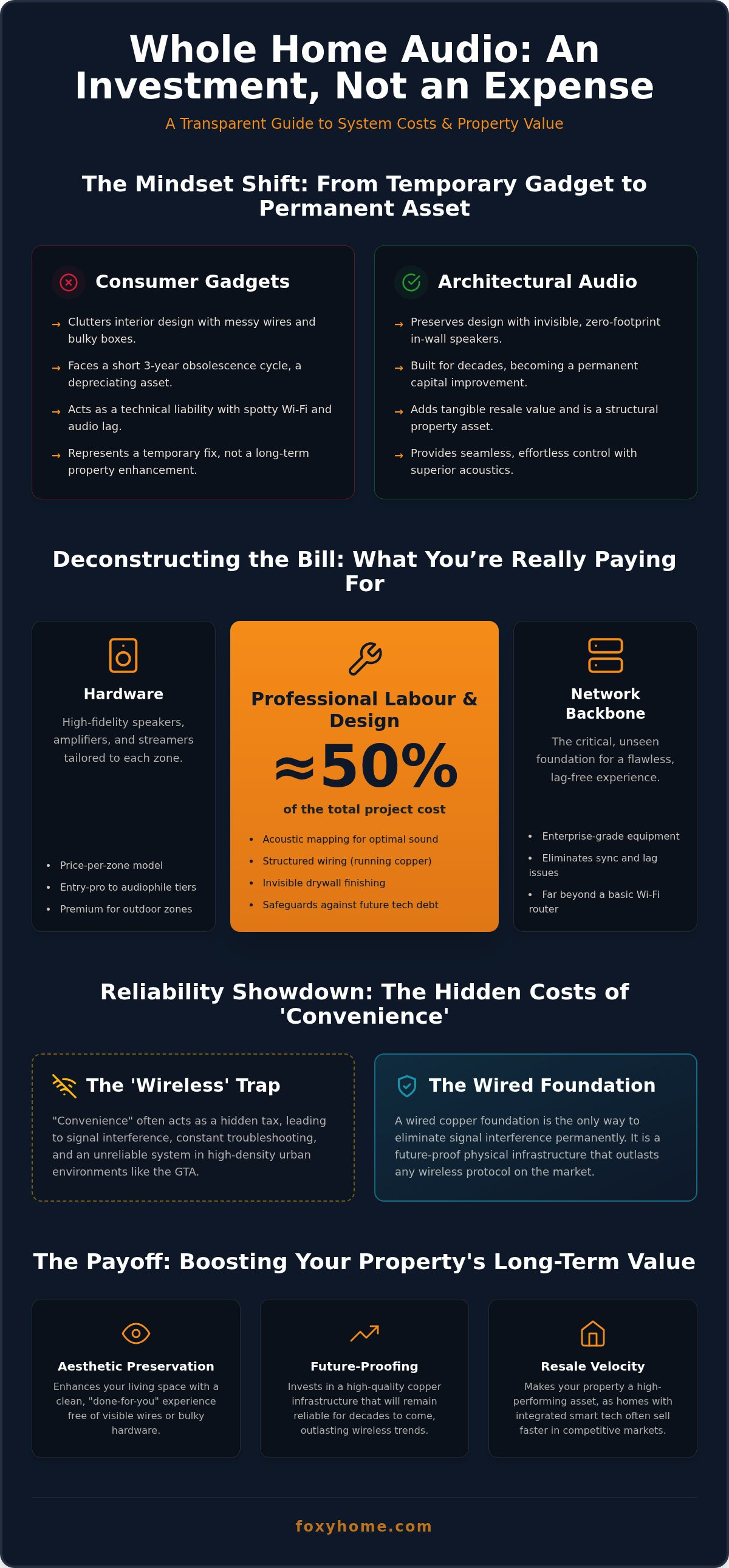
Toronto real estate isn't just about square footage anymore; it's about the intelligence embedded within the walls. When you evaluate the whole home audio system cost, you must stop viewing it as a retail purchase and start seeing it as a capital improvement. A collection of Bluetooth speakers sitting on a shelf is a depreciating gadget. A professional installation, however, is a permanent upgrade to your home's infrastructure. It is the difference between a temporary fix and a strategic investment in your property's net worth.
The Difference Between Consumer and Architectural Audio
Most homeowners confuse consumer-grade electronics with professional architectural audio. In-ceiling and in-wall speakers represent the gold standard for GTA luxury homes. These "invisible" solutions preserve your interior designer's vision while providing superior acoustics that a plastic box on a counter can't match. Unlike consumer units that face a three-year obsolescence cycle, wired multi-room audio systems are built for decades. They offer a zero-footprint lifestyle that appeals to high-net-worth buyers who value clean lines and seamless functionality. When you realize that architectural audio is a permanent fixture, the whole home audio system cost shifts from a "tech expense" to a "structural asset."
Scaling Your Lifestyle and Net Worth
A professionally configured system reduces the daily friction of managing your environment. It isn't just about music; it's about a smart home ecosystem that works without constant troubleshooting. In the Toronto market, integrated tech is a massive resale differentiator. Modern buyers want a "done-for-you" experience. They aren't looking for a messy DIY project that requires a degree in computer science to fix every time the router reboots.
Aesthetic Preservation: No visible wires or bulky hardware cluttering your living spaces.
Future-Proofing: High-quality copper wiring outlasts every wireless protocol currently on the market.
Resale Velocity: Homes with integrated smart tech often sell faster in competitive GTA neighbourhoods.
By shifting your mindset from "buying gadgets" to "stabilizing assets," you avoid the trap of technical debt. Cheap DIY fixes often cost more in the long run because they fail to provide the reliability required for a high-density urban environment. A professional installation ensures your audio system remains a functional tool for generational wealth and personal enjoyment.
Deconstructing the Bill: Components of Audio System Pricing
Stop looking at the sticker price of a standalone speaker and start looking at the total project scope. Most big-box retailers sell you a box; we are talking about an integrated ecosystem. The whole home audio system cost isn't just a tally of amplifiers and streamers. It is a calculated combination of high-fidelity hardware, a robust network backbone, and the specialized labour required to make it all talk to each other. If you ignore the infrastructure, you are just buying expensive paperweights.
Hardware: Choosing Your Level of Fidelity
Hardware is the most visible part of the invoice, but it's often the most misunderstood. You can choose entry-level professional gear or jump into high-end audiophile components that rival a concert hall. When budgeting, remember that adding more rooms doesn't always lead to a linear price hike. You have to consider the price-per-zone of these systems, which accounts for the amplification and streaming capacity needed to drive each area independently. Outdoor zones command a premium due to weatherproofing requirements, ensuring your patio survives a Toronto winter without a total system failure.
The Labour Component: What You Are Actually Paying For
This is where most DIY enthusiasts get burned. Professional labour and design account for nearly half of a successful project. Our technicians don't just "plug things in." They perform acoustic mapping to account for the unique layouts of Toronto homes, whether it's a glass-walled condo or a century-old Victorian. Physical installation involves the gritty reality of structured wiring. We are talking about cutting into drywall, running high-grade copper, and finishing the job so the tech remains invisible. This isn't just labour; it's a safeguard against future technical debt.
Then there is the network backbone. A $50 router from a big-box store will kill a $10,000 audio system. If your network can't handle the data throughput, your music will skip, lag, or simply disappear. We treat your home network like a utility, not an afterthought. This level of precision ensures a "hands-off" experience where you control everything through a single, stable app. If you want to avoid the "wireless tax" and technical instability, it's worth seeing how a professionally designed system protects your investment from day one.
Wired vs. Wireless: The Hidden Costs of Convenience
Convenience is frequently a trap, and in the multi-room audio market, it is known as the "Wireless Tax." Most homeowners assume that ditching the cables saves on the whole home audio system cost, but they ignore the hidden price of signal instability. In a high-density city like Toronto, your Wi-Fi is constantly battling for airtime against your neighbours' routers, smart appliances, and baby monitors. This invisible congestion ruins the luxury experience by creating audio lag and sync issues that a simple app reset won't solve. You have to decide if you want to invest in copper once or pay for technical frustration every time you try to host a dinner party.
Copper remains the undisputed king for high-resolution audio. A wired system provides a dedicated, interference-free highway for your music, ensuring bit-perfect quality and zero lag. While hybrid systems can work by using wireless for portable patio speakers, your primary zones should always be hardwired. This strategy balances modern flexibility with the industrial-grade reliability required for a high-value property. It is about building a system that works the first time, every time, without relying on the whims of a wireless signal.
The Case for Structured Wiring
Future-proofing your home starts before the drywall is even delivered. If you are currently deep in a renovation or a new build in the GTA, running Ethernet-backed audio is the smartest financial move you can make. Toronto’s high-density multi-plexes and stacked townhomes are notorious for Wi-Fi dead zones and signal interference. A wired foundation bypasses these bottlenecks entirely. It transforms your audio setup into a permanent utility, much like your plumbing or electrical system, rather than a collection of gadgets that depend on a shaky connection.
Wireless Limitations in Large Estates
Wireless protocols often buckle in homes exceeding 3,000 square feet. The "drop-out" problem becomes a persistent headache as signals struggle to penetrate modern building materials or travel across multiple floors. Homeowners often try to "fix" this by layering on expensive mesh nodes, which only increases the whole home audio system cost without solving the root cause of the interference. Unmanaged wireless devices also introduce unnecessary security risks to your home network. A wired backbone is inherently more secure, more stable, and significantly more durable for a sprawling Toronto estate.
Maintenance also reveals a stark divide between the two approaches. Wireless units are at the mercy of frequent software updates that can render older hardware obsolete in just a few years. An architectural speaker connected via high-grade wire doesn't care about firmware; it is designed to last for decades without a single glitch or required reboot.
Real-World Budgeting: From Boutique Condos to Post-War Estates
Toronto homeowners often suffer from sticker shock because they rely on generic online calculators that ignore the "Toronto Premium." If you are looking at a US-based guide, you are already behind. The whole home audio system cost in the GTA reflects the complexity of our high-density urban environment and the current hourly rates for skilled AV technicians in Ontario, which typically range from $150 to $200 per hour. You aren't just paying for speakers; you are paying for the expertise to navigate Toronto’s unique building codes and the technical debt of older properties.
Tier 1: The High-Rise Integration
High-rise living in the downtown core presents specific technical hurdles. Concrete walls and steel reinforcements act as signal-killing shields, making a basic wireless setup nearly useless. For urban professionals in a 2 to 3 zone condo (typically the living room, kitchen, and primary bedroom), budgeting must account for strategic wiring or high-gain access points. This level of integration allows for a single-app "Good Morning" scene that gradually fades in your favourite playlist as the blinds rise. It is about maximizing the utility of every square foot in a high-value downtown asset.
Tier 2: The Fully Connected Detached Home
Moving into a detached home or a post-war estate in neighbourhoods like Lawrence Park or High Park changes the financial equation. Here, we are usually looking at 6 or more zones, including critical outdoor areas like the back deck or pool. To maintain stability across several thousand square feet, you must centralize "The Brain" of the system. This involves a dedicated AV rack where amplifiers, streamers, and network switches are housed in a climate-controlled environment.
Centralized Control: Eliminates the clutter of individual components in every room.
Smart Integration: Connecting audio to your lighting and climate systems for maximum lifestyle ROI.
Outdoor Premium: Budgeting for weather-hardened hardware that can survive a Canadian winter.
Toronto properties often hide "quirks" like lath-and-plaster walls or outdated electrical panels that require a contingency fund of roughly 10 percent of the total project. Ignoring these factors is how "simple" installations turn into expensive nightmares. If you want to see how a professional design can stabilize your property’s value, it is time to get a custom quote from FoxyHome. We specialize in the "hands-off" luxury that ensures your system is a permanent asset, not a temporary gadget.
Professional Installation: Protecting Your Equity with FoxyHome
Why hand your home’s technical infrastructure to a retail clerk who doesn't understand the difference between a temporary gadget and a capital improvement? At FoxyHome by PCMNow, we realize that your property is likely your most significant financial holding. We don't just "install speakers." We treat your residence as a strategic asset. When you evaluate the total whole home audio system cost, you aren't just paying for sound; you are paying for the stabilization of your home’s long-term value and the elimination of technical debt.
Our approach is rooted in radical transparency and industrial-grade reliability. Every audio build we undertake starts with an enterprise-grade network backbone. We've seen too many GTA homeowners spend tens of thousands on high-end hardware only to have it crippled by a consumer-grade router. By prioritizing the network, we ensure your system remains a seamless, "hands-off" luxury rather than a persistent troubleshooting headache. We manage the complexity so you can enjoy the results.
The FoxyHome Difference
Our expert technicians are battle-hardened by the unique challenges of Toronto’s residential structures. Whether you are dealing with the thick masonry of a Rosedale century home or the signal-blocking steel of a modern downtown penthouse, we know how to navigate the pitfalls. We offer a "straight-talk" pricing model that eliminates the hidden fees and "free" app traps common in the traditional market. Our goal is to build a system that evolves with 2026 technology, protecting your equity from the rapid obsolescence that plagues consumer electronics.
Bureaucracy Management: We handle the grit of city permits and construction coordination.
Dust-Free Execution: Our team treats your interior design with the respect it deserves, leaving no trace but the sound.
Legacy Support: We provide ongoing configuration to ensure your smart home ecosystem remains peak-performance.
Next Steps: From Curiosity to Conviction
The transition from a cluttered, glitchy setup to a professional multi-room system begins with a comprehensive asset audit. During your initial design consultation, we map out your home’s acoustic potential and identify the structural requirements for a wired backbone. We don't believe in high-pressure sales; we believe in providing the data you need to make an informed investment. We minimize disruption by planning every cut and cable run before we even arrive on-site, ensuring a streamlined installation phase that respects your schedule.
Are you ready to stop fighting with your Wi-Fi and start enjoying a system that adds genuine resale velocity to your property? It is time to Audit your home’s potential with a FoxyHome expert. Let us show you how a professionally designed whole home audio system cost can be the smartest improvement you make this year.
Invest in Sound, Stabilize Your Legacy
Stop letting mediocre tech devalue your Toronto property. You now understand that a professional multi-room setup is a permanent capital improvement, not a retail whim. By prioritizing a wired foundation and an enterprise-grade network backbone, you eliminate the technical instability that plagues typical consumer-grade systems. The whole home audio system cost is a strategic investment in your home's resale velocity and your daily quality of life. Don't settle for messy wires or spotty Wi-Fi that sabotages your interior design. Our professional GTA-based technicians bring integrated smart home and security expertise to every project, ensuring your system is a seamless extension of your lifestyle. It is time to move from technical debt to technical empowerment. You have the roadmap; now it is time to build the infrastructure your home deserves. Secure your Toronto home’s audio future—Book a consultation. Your property is an asset, and it's time it sounded like one.
Frequently Asked Questions
How much does a basic 4-room audio system cost in Toronto?
A 4-room setup depends on whether you choose architectural in-ceiling speakers or standalone units. The whole home audio system cost is largely driven by the structural complexity of your Toronto home and the hardware fidelity you demand. Professional labour in Ontario typically bills between $150 and $200 per hour. Expect the project to include amplification, streaming hardware, and high-grade copper wiring. Investing in a wired foundation ensures your four rooms stay in perfect sync without the lag common in DIY setups.
Will a whole home audio system increase my property value?
Yes, integrated technology acts as a massive resale differentiator in the competitive GTA market. Modern buyers view professional audio as a permanent structural upgrade rather than a collection of gadgets. It increases your home's resale velocity by offering a "move-in ready" luxury experience. While the return isn't always one-to-one, it stabilizes your property's value by future-proofing the infrastructure. High-net-worth buyers in neighbourhoods like Forest Hill prioritize these invisible, high-performing assets over visible clutter.
Can I add multi-room audio to an older Toronto home without tearing down walls?
You don't always need to tear down walls to achieve professional sound. Expert technicians use specialized retrofitting tools and strategic wiring paths through attics, basements, or crown moulding to reach your desired zones. While older Toronto homes with lath-and-plaster present unique challenges, a "hands-off" professional installation manages these pitfalls without a full-scale renovation. We focus on preserving your home's historic character while embedding enterprise-grade technology into the existing structure for a zero-footprint finish.
What is the difference between Sonos and a professional wired system?
Sonos is a consumer-grade wireless ecosystem, while a professional wired system is a permanent utility. Wireless units are susceptible to signal interference in high-density Toronto multi-plexes and face a shorter lifespan due to software obsolescence. A wired system uses high-fidelity copper and centralized amplification to deliver bit-perfect audio with industrial-grade reliability. While Sonos offers entry-level convenience, it can't match the zero-lag performance or the long-term property value provided by a hardwired architectural installation.
How long does a professional audio installation typically take?
A standard professional installation typically spans three to five business days for a mid-sized home. This timeline accounts for the "straight-talk" reality of cutting, wiring, and finishing without leaving a mess. More complex GTA estates with ten or more zones may require up to two weeks for full calibration and network optimization. We prioritize a "hands-off" process that minimizes disruption to your daily life while ensuring every component is programmed for a seamless user experience.
Do I need a special internet plan for a multi-zone audio system?
Your ISP speed matters less than your internal network hardware. A basic 1Gbps plan is sufficient, but your whole home audio system cost must include an enterprise-grade network backbone. Consumer routers from big-box stores often buckle under the data throughput of multi-zone audio. We install robust networking solutions that treat your Wi-Fi like a utility. This ensures your music, security cameras, and smart lighting operate on a dedicated, high-speed highway without competing for bandwidth.
Can I control my security and audio from the same app?
Absolutely. FoxyHome specializes in integrated smart home ecosystems that consolidate audio, security, lighting, and climate into a single interface. You can arm your security system and start your "Dinner Party" playlist from the same app with one tap. This level of synchronization eliminates the friction of jumping between multiple "free" apps that don't talk to each other. It transforms your property into a cohesive tool for convenience, safety, and generational wealth.
What happens if my Wi-Fi goes down—will the music stop?
If you rely solely on a wireless setup, your music will stop the moment your Wi-Fi glitches. This is why we advocate for a wired backbone. Hardwired architectural speakers continue to function through your local network even if your external internet connection fails. In a high-density urban environment like the GTA, wireless signals are technical liabilities. A professional wired installation ensures your home remains operational and your atmosphere remains intact regardless of your router’s mood.

Comments