
Smart Home Accessibility Features for Disabled Residents: Building Independence Infrastructure
Your home should be your greatest financial and personal asset, yet for many residents, it functions more like a high-stakes obstacle course. It's a blunt truth that traditional Toronto housing wasn't built for modern mobility, and the clinical, medicalized solutions of the past are an insult to both your style and your wallet. You deserve a space that's empowering and sophisticated, where technology serves you without demanding constant troubleshooting or looking like a hospital ward.
We understand the frustration of tech that fails when you need it most and the desire for a home that feels like a sanctuary, not a facility. By integrating professional smart home accessibility features for disabled residents, you can reclaim total control over your environment while future-proofing your property value. This article explores how enterprise-grade infrastructure transforms daily tasks like lighting, climate, and entry into seamless, hands-off operations. We will look at the strategic shift from making do to building a legacy of independence through reliable, integrated systems that actually work for you.
Table of Contents
Beyond Gadgets: Why Smart Home Accessibility is Strategic Infrastructure
Stop thinking of smart tech as a collection of expensive toys for the tech-obsessed. In the context of disability, these systems represent "Independence Infrastructure," which refers to integrated logic that replaces physical strain with automated outcomes. Smart home accessibility is the professional integration of assistive technologies to remove physical barriers. We aren't just talking about a voice-activated speaker; we're talking about comprehensive smart home accessibility features for disabled residents that stabilize your home as a long-term living asset.
This evolution in home automation for elderly and disabled individuals has shifted the conversation. It has moved from "nice-to-have" gadgets to essential tools for autonomy. When your environment anticipates your needs, the house stops being an obstacle and starts being a partner. It becomes a space that scales with your requirements rather than one that forces you out as your mobility needs change.
The Financial Logic of Accessibility Upgrades
Toronto's real estate market is a battlefield, and you need every advantage possible. Accessibility upgrades aren't just renovation costs. They are strategic investments that increase your property's net worth and future-proof its utility. Consider the long-term financial drain of manual care. Professional automation reduces the reliance on expensive, around-the-clock in-home assistance by enabling you to perform daily tasks solo. By scaling your independence, you're protecting your capital. You are ensuring your home remains a tool for wealth and legacy rather than a financial burden.
Disrupting the "Medical" Home Aesthetic
Nobody wants their living room to look like a long-term care facility. Traditional assistive devices are often clunky, clinical, and visually loud. They scream "patient" rather than "homeowner." This "medicalization" of the home can be demoralizing. Professional smart home accessibility features for disabled people use invisible technology to provide hospital-grade utility without the sterile aesthetic. Modern sensors, sleek control panels, and voice interfaces preserve the architectural integrity of your space. There is a profound psychological victory in using the same high-end tech as your neighbours, just optimized to handle the heavy lifting for you.
The Core Pillars of an Accessible Smart Home
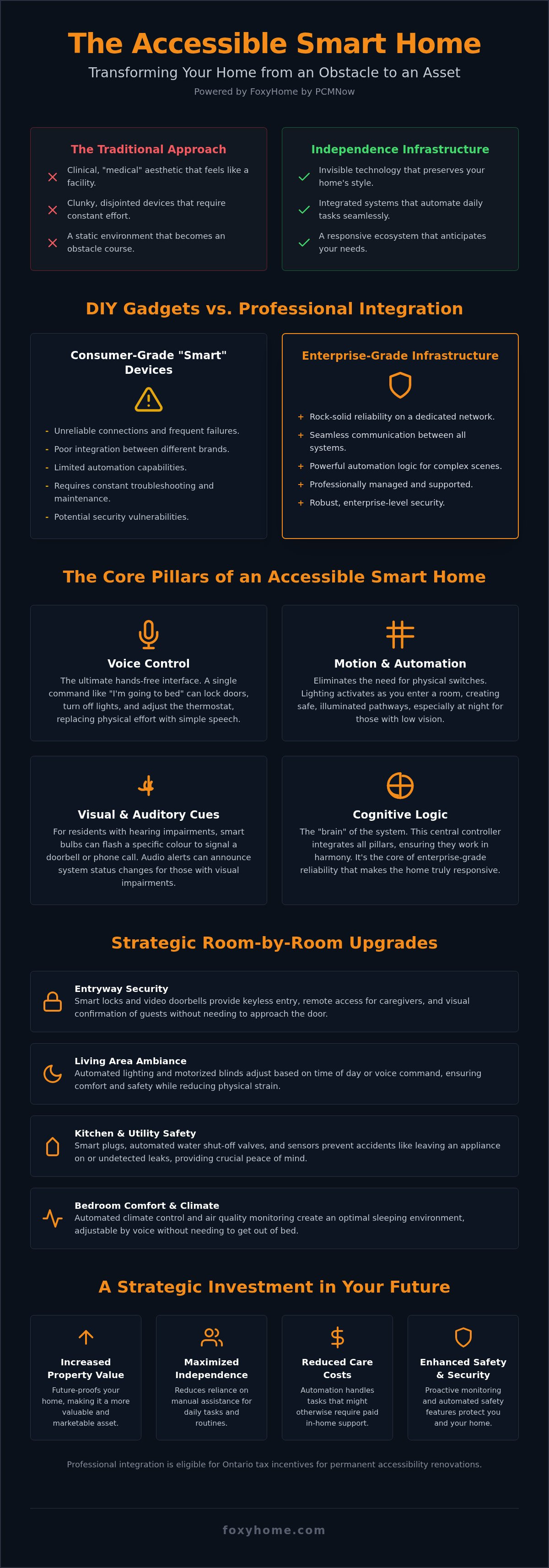
True independence isn't about one gadget; it's about a synchronized system. When we deploy smart home accessibility features for disabled residents, we focus on four core pillars: voice, motion, visual cues, and cognitive logic. These aren't separate silos. They are the interlocking gears of a functional environment. By layering these technologies, we transform a static building into a responsive ecosystem that anticipates your movement and reacts to your commands. This strategic layer of smart home accessibility features for disabled users ensures that your home works for you, not the other way around.
Voice and Natural Language Processing
For residents with limited mobility or quadriplegia, voice is the ultimate interface. It's the difference between waiting for help and taking immediate action. Simple voice commands aren't enough. Professional integration allows for complex "scenes." A single phrase like "I'm going to bed" can lock the doors, dim the lights, and set the thermostat. This level of Accessible Smart Home Technology requires a robust foundation. If your voice assistant "forgets" how to talk to your lights because of a cheap router, your independence vanishes. Reliability is the only metric that matters here.
Smart Lighting and Visual Pathfinding
Physical switches are relics of an inaccessible era. We use motion sensors to eliminate the "reach" requirement entirely. Lighting should be adaptive, guiding users with low vision through hallways with soft, automated paths at night. We also use visual feedback as a communication tool. For the hearing impaired, smart bulbs can flash a specific colour to signal a doorbell, a phone call, or a water leak. This transforms audio alerts into actionable visual cues, ensuring no critical information is missed. If you're ready to modernize your space, our team can help you design a custom integrated system that fits your specific mobility profile.
Climate and Air Quality Control
Precise thermoregulation is often a medical necessity, not just a comfort choice. Certain conditions make residents highly sensitive to temperature fluctuations. Automated climate systems maintain exact levels without requiring the user to reach a wall-mounted unit. We also integrate air quality sensors. These systems can automatically trigger high-grade filtration or humidity adjustments to support respiratory health. By offloading these tasks to an automated system, we reduce the "mental load" of home management. This allows you to focus on living rather than managing the minute details of your environment.
DIY vs. Professional Integration: Why Your Setup Needs Enterprise Reliability
Do you trust your independence to a $20 bridge and a glitchy app? For a typical homeowner, a smart bulb that fails to respond is a minor nuisance. For someone relying on smart home accessibility features for disabled residents, that same failure is a crisis. This is the "Reliability Gap." DIY gadgets are designed for hobbyists who don't mind occasional troubleshooting. Professional integration is designed for people who need their environment to work every single time without fail. When your mobility or safety is on the line, "mostly working" is the same as "not working at all."
The bottleneck is usually your ISP-provided router. These plastic boxes are not built to handle the high-density traffic of a truly automated home. They struggle with the constant pings of sensors, cameras, and voice interfaces. This leads to the dreaded "No Response" error in your control centre. We also see massive "App Fatigue" in DIY setups. Managing twelve different apps for lights, locks, and climate is a cognitive and physical drain. A professional system consolidates everything into a single, hardened interface that just works.
Enterprise-Grade Networking as the Foundation
Your accessibility tech is only as strong as its backbone. We build systems on enterprise-grade mesh networking and wired backhauls to ensure zero dead zones. This isn't just about speed; it's about stability. For disabled users, network uptime is not a luxury; it is a life-critical utility. By moving away from consumer-grade Wi-Fi, we eliminate the lag and connectivity drops that plague DIY setups. We also harden your smart locks and cameras against security threats. Professional configuration ensures your front door is a digital fortress, not a vulnerability in your network.
The Hands-Off Advantage
The goal of FoxyHome is to manage the complexity so you only experience the benefit. We don't expect you to hunt through forums or reboot routers when a scene fails. Our technicians handle the design, configuration, and ongoing support. We use the "Joe and Maria" test to ensure every system is intuitive. If it isn't easy enough for every family member to use without a manual, it isn't ready. This hands-off approach ensures that your smart home accessibility features for disabled living remain a tool for empowerment, not a source of technical frustration. You get a local expert on call, ensuring your independence infrastructure remains operational 24/7.
Strategic Room-by-Room Upgrades for Ontario Homes
General advice won't help you navigate a narrow Cabbagetown Victorian or a multi-level North York semi-detached. Toronto's unique architectural quirks often turn daily life into a series of physical negotiations. By strategically deploying smart home accessibility features for disabled residents in every room, you stop reacting to your environment and start commanding it. We look at your property as a tool for autonomy. From the front curb to the master ensuite, every square foot should be optimized to reduce friction and maximize safety.
Entryways and Perimeter Security
Toronto's older housing stock often features cramped foyers and heavy doors that are nightmare scenarios for wheelchair users or those with limited grip. Biometric smart locks and RFID sensors eliminate the "key fumble" entirely. You can grant access to a therapist or a nurse remotely through a voice command or a single tap on your phone. This isn't just about convenience; it's about secure, audit-trailed management of your care circle. Retrofitting these "GTA-style" entryways with modern access tech ensures that your home remains a fortress for you and a welcoming space for those you trust.
The Accessible Kitchen
The kitchen is the most dangerous room in any house. We mitigate risk by integrating induction cooktops that only heat the pan, not the surface, coupled with smart sensors that automatically shut off the gas or power if a burner is left unattended. Voice-controlled faucets and smart appliances allow for "hands-full" cooking, which is critical for residents with limited manual dexterity. We also organize task lighting to activate automatically based on occupancy, reducing eye strain and preventing falls in high-traffic prep areas.
Ontario Tax Credits and Incentives
Don't let the upfront costs deter you from building your independence infrastructure. For the 2026 tax year, the Ontario Home Accessibility Tax Credit (HATC) allows you to claim 15% of up to $20,000 in eligible expenses for permanent accessibility renovations. This provides a maximum tax reduction of $3,000. Additionally, the federal Multigenerational Home Renovation Tax Credit offers a 15% refund on up to $50,000 for creating secondary suites for qualifying individuals. Professional installation is vital here; we provide the precise documentation and "asset stabilization" proof required to justify these claims to the CRA. If you're ready to maximize your return, book a professional accessibility audit today to see which credits apply to your project.
FoxyHome’s Approach: Custom Accessibility Design in the GTA
FoxyHome doesn’t just sell gadgets. We build independence infrastructure. Our approach begins with the FoxyHome Audit, where we stop viewing your house as a series of physical limitations and start seeing it as a strategic tool for wealth and autonomy. We identify exactly where your home’s architecture is failing you and how professional smart home accessibility features for disabled residents can stabilize that asset. We aren't interested in cookie-cutter kits or the shiny plastic sold in big-box stores. Every system we design is built around your specific mobility profile, ensuring the technology moves at your pace, not the other way around.
Professional execution is what separates a reliable system from a dangerous DIY experiment. Our technicians handle the gritty industry work of hard-wiring, network optimization, and backend configuration. We ensure your smart home accessibility features for disabled living are integrated directly into your home’s foundation. This isn't just about sticking a sensor on a wall; it's about enterprise-grade reliability. We provide a Peace of Mind Guarantee because we know that for you, a system failure isn't just an inconvenience. It's a breach of your independence.
Our Process: From Consultation to Conviction
Our design consultations are rooted in straight-talk. We tell you exactly what you need to scale your independence and, more importantly, what is just expensive fluff. We focus on seamless integration, ensuring your new tech talks to your existing Toronto architecture without creating a digital mess. Once the installation is complete, we don't just walk away. We handle the training and handover, staying on-site until you are the absolute master of your own domain. You get a system that works the first time, every time, managed by a team that understands the local GTA landscape.
Ready to Scale Your Independence?
Waiting for a physical crisis to upgrade your home is a poor financial strategy. It leads to rushed decisions, inflated costs, and unnecessary stress. The FoxyHome difference is that we are visionary truth-tellers in a market saturated with gadget-sellers. We help you transform your property from a burden into a high-performance environment that protects your legacy and your freedom. Stop negotiating with your own hallways. Take control of your environment before the market or your mobility forces your hand. Book your Toronto Smart Home Accessibility Audit today and start building the infrastructure your future self deserves.
Secure Your Legacy of Independence
You've seen the difference between a house cluttered with gadgets and a home built on true independence infrastructure. Accessibility isn't a secondary concern or a luxury add-on; it's a strategic move to stabilize your asset and reclaim your personal autonomy. By prioritizing enterprise-grade reliability over DIY shortcuts, you ensure that your environment works for you 24/7. You are no longer negotiating with your own hallways. You are commanding them.
Integrating smart home accessibility features for disabled residents transforms your space into a high-performance sanctuary that scales with your needs. Our Toronto-based expert technicians handle the heavy lifting. We focus on enterprise-grade networking foundations and seamless single-app integration. We eliminate the clinical aesthetic in favour of modern, invisible technology that preserves the feel of your home while providing hospital-grade utility. It's time to stop making do and start building a space that serves your long-term vision.
Don't wait for a crisis to force a rushed renovation. Book Your Professional Accessibility Consultation today to audit your property and realize its full potential. You deserve a home that empowers your future and protects your freedom. Let's build your new standard of living together.
Frequently Asked Questions
What are the most essential smart home features for someone with limited mobility?
The most essential smart home accessibility features for disabled residents with limited mobility include hands-free voice control, automated motion sensors for lighting, and smart locks. These systems eliminate the need to physically reach for switches or fumble with keys. By integrating these into a single-app interface, we remove the friction of daily tasks. In Toronto's older homes, these upgrades provide immediate relief from architectural barriers that traditional renovations cannot solve as efficiently.
Can smart home technology help with dementia or memory loss?
Yes, smart technology provides critical cognitive support through automated routines and safety monitoring. Features like automated stove shut-off valves and smart leak detectors prevent accidents before they happen. We also configure "wayfinding" lighting that activates at night to guide residents safely. These systems reduce the mental load on both the resident and their caregivers, providing a layer of automated logic that maintains a safe environment without constant manual intervention.
Is there government funding in Ontario for smart home accessibility upgrades?
Ontario residents can access several financial incentives for accessibility upgrades. For the 2026 tax year, the Home Accessibility Tax Credit (HATC) allows a claim of 15% on up to $20,000 in eligible expenses. Additionally, the federal Multigenerational Home Renovation Tax Credit provides a 15% refund on up to $50,000 for creating secondary suites. Professional installation ensures you have the robust documentation required by the CRA to justify these strategic independence investments.
Do I need to rewire my entire Toronto home for these features?
Total rewiring is rarely necessary because we utilize high-performance wireless mesh networking as the system's backbone. While some components like smart switches or security cameras benefit from localized power, modern enterprise-grade Wi-Fi handles the communication load without tearing down walls. This is particularly advantageous for Toronto's historic properties where invasive construction is costly. We focus on stabilizing the existing infrastructure with professional configuration rather than starting from scratch.
How reliable is voice control for emergency situations?
Voice control is highly reliable when built on a professional enterprise-grade network, but it shouldn't be your only safety net. We configure systems with local processing to ensure commands work even if the internet flickers. For life-critical situations, we recommend integrating voice with physical emergency buttons and automated alerts. This multi-layered approach ensures that your independence infrastructure remains operational when you need it most, regardless of external network stability.
Which smart home ecosystem (Apple, Google, Amazon) is best for accessibility?
There is no single "best" ecosystem; the right choice depends on your specific mobility needs and existing devices. Apple Home offers strong privacy and Siri integration, while Google and Amazon provide broader hardware compatibility. We focus on the "Matter" protocol to ensure cross-brand interoperability. Our technicians design the system to be ecosystem-agnostic, ensuring your smart home accessibility features for disabled living aren't locked into a platform that might become obsolete.
Can smart home features increase the resale value of my Toronto property?
Strategic accessibility upgrades significantly increase the resale value of Toronto properties by tapping into the growing "aging-in-place" market. A home that is already "barrier-free" and professionally automated is a high-performance asset that attracts a wider demographic. You aren't just installing gadgets; you are future-proofing the building's utility. In a competitive market like the GTA, these integrated systems transform a standard house into a premium, move-in-ready environment for diverse buyers.
How does FoxyHome ensure my data and privacy are protected?
FoxyHome prioritizes your security by implementing enterprise-grade encryption and local data storage whenever possible. We move away from vulnerable cloud-only setups that sell your habits to third parties. By hardening your network and using professional-grade routers, we ensure your cameras and sensors are digital fortresses. We treat your home data as a private asset, configuring your system so that your daily routines remain your business and no one else's.


Comments