
Smart Home Integration with Security Systems: The 2026 Toronto Asset Strategy
Your Toronto property isn't a playground for hobbyist gadgets, yet most homeowners treat their tech like a collection of expensive toys rather than a stabilized financial asset. If you're currently juggling five different apps to lock your doors and dim your lights, you aren't living in the future; you're just managing a digital headache. We realize that app fatigue and unreliable Wi-Fi dropouts have turned the dream of a seamless home into a fragmented mess of "smart home scams" and outdated hardware. It's time to stop playing IT support for your own house.
Professional smart home integration with security system protocols is the only way to bridge the gap between lifestyle automation and high-stakes protection. You deserve a hands-off, secure environment that actually increases your property value instead of just draining your patience. This article outlines the 2026 Toronto strategy to eliminate daily friction, consolidate your control into a single interface, and protect your equity with the latest AI-driven tech. We're moving past the DIY chaos to show you how a unified system turns your residence into a fortified, high-performance asset.
Table of Contents
Beyond the App: Why Fragmented Smart Homes Are a Financial Liability
The Integrated Ecosystem: How Professional Networking Stabilizes Your Security
Security-First Automation: Choosing Hardware That Protects Your Equity
DIY vs. Professional Integration: Avoiding the 'Smart Home Scams'
Future-Proofing Your Toronto Multi-plex: The FoxyHome Integration Playbook
Beyond the App: Why Fragmented Smart Homes Are a Financial Liability
If you have to open three different apps just to see who is at the front door and let them in, your home isn't smart. It's just complicated. Most Toronto homeowners have fallen into the gadget trap, buying a doorbell here and a thermostat there, only to realize they've built a digital house of cards. A fragmented system isn't just a nuisance; it's a financial liability that creates massive security gaps. True smart home integration with security system protocols means your hardware talks to a single central brain, ensuring your lifestyle automation doesn't compromise your perimeter.
Investors across the GTA are waking up to a gritty reality. A collection of mismatched devices from big-box stores doesn't add value to a multi-million dollar asset. Instead, it signals to future buyers that the property is a maintenance nightmare waiting to happen. High-net-worth buyers don't want a keychain of digital logins or ten different cloud accounts that each represent a potential point of entry for a breach. They want a stabilized environment where the tech works in the background, invisible and reliable. Moving away from "gadget culture" toward a professional tech stack is how you protect your equity in an increasingly tech-reliant market.
The Reality of Technical Friction
Disconnected systems are notorious for failing exactly when you need them. Imagine a security event where your cameras detect motion, but your smart lights don't trigger because they're on a different protocol. Or worse, your smart lock goes offline because of a firmware mismatch with your bridge. This friction is more than an inconvenience; it's a vulnerability. Smart home integration is the elimination of digital silos. By unifying your hardware, you remove the maintenance nightmare of managing ten different update cycles and ensure that every device acts as a cohesive unit during an emergency.
Protecting Your Home Equity with Unified Tech
Modern Toronto real estate appraisals are beginning to reflect the quality of a home's digital infrastructure. A professional smart home integration with security system setup is now viewed with the same weight as premium HVAC or custom millwork. In neighbourhoods like Rosedale or the Bridle Path, "invisible" tech is the standard. This means no clunky hubs or tangled wires, just a single-app ecosystem that controls everything from the security perimeter to the climate. For a busy professional, this level of control is non-negotiable. It provides the peace of mind that comes with a "hands-off" secure home, ensuring your property remains a competitive, high-value asset in the Toronto market.
The Integrated Ecosystem: How Professional Networking Stabilizes Your Security
The router your ISP gave you for free is a digital screen door. It was built for mass-market convenience and streaming Netflix, not for the rigorous demands of guarding a high-value asset. When you rely on a single, congested Wi-Fi channel to manage your family's entertainment and your perimeter cameras, you're inviting a system-wide collapse. A professional smart home integration with security system requires a dedicated "Networking Backbone." This means moving beyond basic setups and implementing VLANs (Virtual Local Area Networks) to isolate your security traffic. By putting your cameras and smart locks on their own encrypted lane, you ensure that a compromised smart bulb doesn't provide a back door into your private data or your security feed.
Let's address the gritty truth about wireless hardware. In 2026, signal jamming and interference are legitimate threats to residential security in high-density urban areas. While wireless cameras are convenient for DIY hobbyists, they are prone to latency and signal dropouts. For high-bandwidth 4K security feeds, wired connections remain the gold standard. If your strategy requires wireless components, enterprise-grade hardware is a non-negotiable requirement. These systems utilize multiple access points to create a seamless mesh that handles heavy data loads without dropping a single frame of evidence. It's the difference between a grainy, stuttering clip and a crystal-clear record of an event.
Wi-Fi 6 and Matter: The New Standards of Reliability
The Matter protocol has finally killed the "it doesn't work together" excuse that plagued the early 2020s. It allows devices from different manufacturers to communicate locally, bypassing the cloud for faster, more secure responses. For your smart locks and sensors, we move beyond flaky Bluetooth to Thread networking, which creates a self-healing mesh of devices. Combined with the high-capacity bandwidth of Wi-Fi 6 and the newly available Wi-Fi 7 standards, your home can handle dozens of concurrent devices without the stuttering lag that characterizes fragmented DIY setups. This interoperability ensures your tech stack remains relevant as new hardware hits the market.
Professional Grade vs. Consumer Grade Networking
Whether you're securing a sprawling Etobicoke estate or a narrow, multi-storey Toronto townhome, dead zones are the enemy of a secure perimeter. Consumer-grade mesh kits often struggle with the thick brick, concrete, and plaster found in GTA architecture. Professional configuration eliminates these gaps while prioritizing local data storage over vulnerable cloud-only systems. Keeping your footage on a local NVR (Network Video Recorder) ensures your security remains active even during an internet outage. When you're ready to stop gambling with your uptime, professional networking design provides the stability your asset requires. This is about moving from "hoping it works" to knowing it does.
Security-First Automation: Choosing Hardware That Protects Your Equity
Why are you letting a twenty dollar smart bulb dictate the logic of your home? It's time to flip the script on how you view automation. In a professional smart home integration with security system, security isn't an accessory; it's the foundation of the entire tech stack. When you put security at the centre of the automation web, every other device serves a protective purpose. Your lights aren't just for ambiance; they're for deterrence. Your thermostat isn't just for comfort; it's for asset preservation. This hierarchy ensures that when your alarm triggers, your entire home responds in unison to defend your equity.
Smart Locks and Professional Access Control
Managing access in a Toronto multi-plex shouldn't involve a box of physical keys or flaky "stick-on" smart adapters that sit over your existing hardware. We prioritize Grade-1 deadbolts because your digital security is only as strong as its weakest physical link. These systems allow for one-touch arming, where locking the door automatically secures the entire perimeter and adjusts your lighting. For property owners, this is a massive financial advantage. You can grant or revoke access for tenants, cleaners, or contractors instantly, eliminating the cost and friction of re-keying locks every time a lease ends or a key goes missing.
Environmental Sensors: The Unsung Heroes of Security
Did you realize that water damage is the leading cause of property insurance claims in Ontario? Smart leak detectors are the unsung heroes of asset stabilization. By integrating these sensors with your main water shut-off valve, you can stop a burst pipe in its tracks before it destroys your basement or your tenant's belongings. Similarly, integrated smoke and CO detectors must talk to your HVAC system. In a fire event, your smart home integration with security system can automatically shut down the furnace to prevent smoke from circulating throughout the property. This level of environmental automation stabilizes your long-term maintenance overheads and protects the structural integrity of your building.
Don't settle for simple "on/off" timers for your lighting. True deterrent lighting uses randomized patterns and occupancy simulation that mimics real human activity, making your home a hard target even when you're away. In Toronto, extreme temperature swings wreak havoc on empty properties. Integrated climate control ensures your pipes don't freeze during a January cold snap and your humidity stays controlled in July, preventing mould growth and protecting your high-end finishes. This isn't just "smart" living; it's strategic asset management that removes the daily friction of property ownership.
DIY vs. Professional Integration: Avoiding the 'Smart Home Scams'
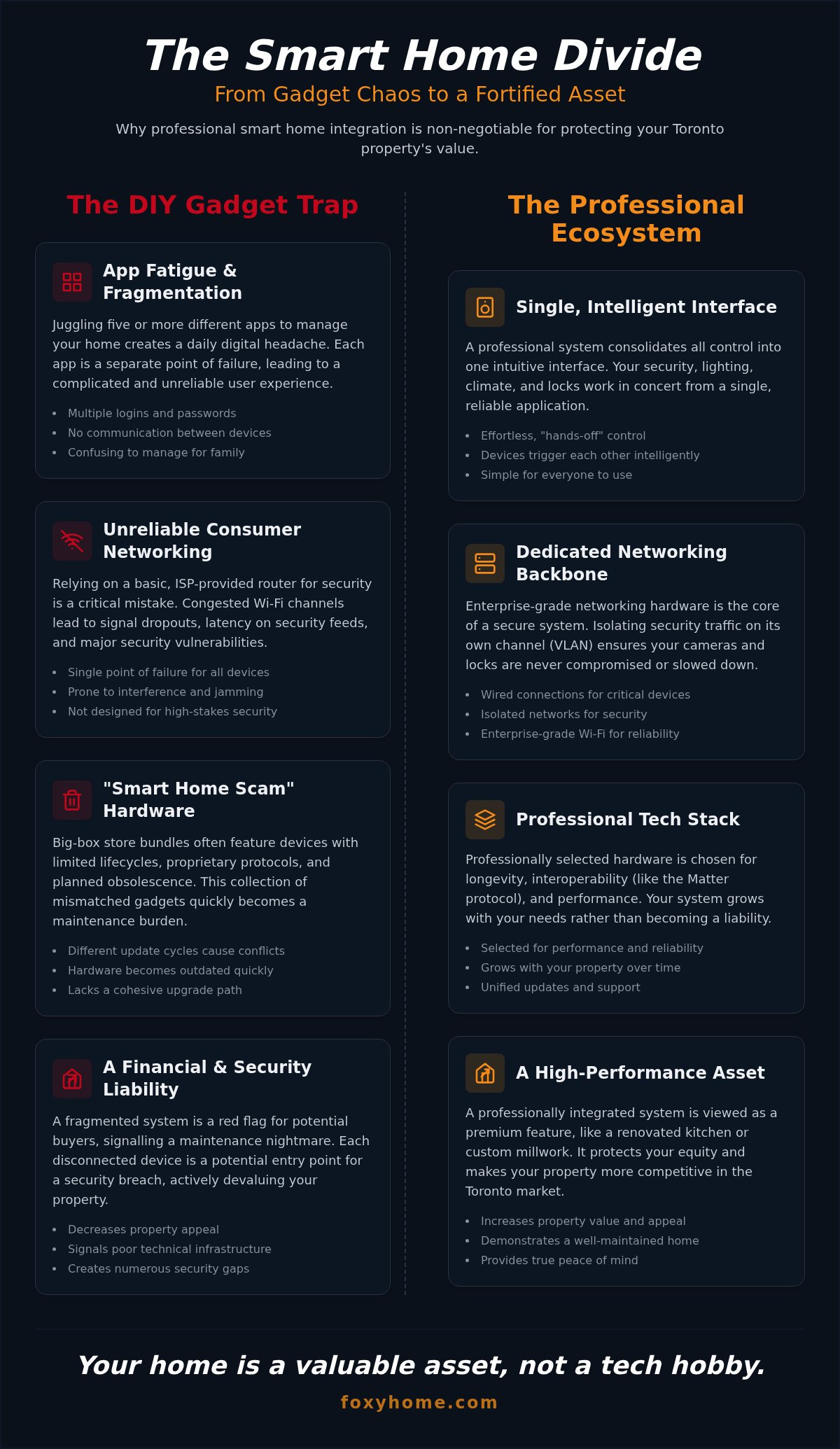
Why are you spending your weekends acting as a junior IT technician for a system that is supposed to protect your family? The DIY "tax" is real, and it is expensive. It is not just the upfront cost of the gadgets; it's the dozens of hours lost to troubleshooting, re-pairing devices, and managing "smart home scams" that promise simplicity but deliver frustration. Most big-box store bundles are engineered for planned obsolescence. They lead you down a path of dead-end technology that requires a total teardown the moment you want to scale your system or add a new feature.
The gritty industry truth is that professional smart home integration with security system protocols is about more than just mounting cameras. It is about liability and long-term asset stabilization. Insurance providers in Ontario are increasingly discerning. A professional certificate of installation can often lead to reduced premiums, whereas a DIY kit with no verified monitoring might leave you exposed during a claim. When you invest in a professional tech stack, you aren't just buying hardware; you're buying a relationship with an expert who ensures your system remains online, updated, and effective.
The Pitfalls of 'Plug-and-Play' Security
Consumer-grade "plug-and-play" kits are notorious for hidden failure points. Poor camera angles often leave massive blind spots, and weak signal strength leads to critical footage dropouts exactly when you need them most. Then there's "subscription creep," where you realize you're paying ten different monthly fees for ten different cloud accounts. Industry estimates suggest that the average Toronto property owner wastes over forty hours annually playing IT support for their own fragmented gadgets. This is time that could be spent growing your portfolio or enjoying your home, rather than fighting with a doorbell that won't connect to the Wi-Fi.
What a Professional Integration Audit Actually Looks Like
A professional audit doesn't start with a catalogue of products; it starts with your floor plan. Whether you're securing a sprawling Etobicoke estate or a dense downtown loft, the strategy must be bespoke. We look at the networking backbone, the physical perimeter, and the specific lifestyle needs of the residents to create a "hands-off" environment. The goal is a system you never have to think about because it works perfectly in the background. If you're ready to stop gambling with your security, it's time for a Smart Home Design Consultation to map out a unified strategy. Moving toward professional installation and configuration ensures your smart home integration with security system is a durable asset rather than a digital liability.
Future-Proofing Your Toronto Multi-plex: The FoxyHome Integration Playbook
Scaling your lifestyle shouldn't require a demolition crew. In the GTA, where space is at a premium and multi-plex conversions are the primary tool for urban density, your tech needs to be as flexible as your floor plan. A professional smart home integration with security system allows you to add features, such as automated tenant access or secondary suite monitoring, without tearing out the foundation of your networking backbone. We focus on asset stabilization, turning your property into a turnkey investment that stands out in the competitive Toronto market. Integrated tech makes your property more "sellable" because it promises the next owner a friction-free experience from day one.
The FoxyHome approach is built on radical transparency and expert setup. We don't just sell hardware; we design internal systems that function like industrial machinery: durable, reliable, and easy to manage. By removing the technical friction of daily life, we ensure your property remains a strategic advantage rather than a maintenance burden. This is about moving from "hoping it works" to knowing your equity is protected by a system that scales alongside your portfolio.
Designing for Generational Wealth
High-net-worth buyers in 2026 aren't looking for a house they have to fix; they're looking for a secured asset they can step into immediately. Integrating sophisticated tech into older Toronto retrofits, those beautiful Annex Victorians or Cabbagetown row houses, requires a surgeon's touch to maintain character while adding modern utility. FoxyHome acts as the expert mentor in this process, managing the complexity of technical design and construction pitfalls so you don't have to. We ensure your legacy is protected by tech that is built to last, not just to trend. Tech-ready homes are the preferred choice for investors who realize that modern security is a non-negotiable requirement for high-density living.
Your Perimeter Audit: The First Step to a Secured Asset
A professional security and automation assessment is the only way to prioritize your tech spend for the highest ROI. We look at everything from entry points to environmental vulnerabilities, providing a roadmap for execution that matches your financial goals. This audit isn't just a checklist; it's a strategic deep-dive into how your property can work harder for you. It's time to stop guessing and start building a "hands-off" secure environment. Book your Toronto Smart Home Design Consultation today. Ready to eliminate the friction? Taking the first step toward a secured asset means moving from curiosity to conviction and ensuring your smart home integration with security system is configured for maximum impact.
Take Control of Your Toronto Asset Strategy
Your Toronto property is too valuable to leave to the whims of fragmented DIY gadgets and congested Wi-Fi. We've shown that true asset stabilization requires moving past the "gadget" phase and into a unified, professional ecosystem. By prioritizing a robust networking backbone and security-first automation, you eliminate the daily friction of managing digital silos while protecting your long-term equity and property value.
Achieving a seamless smart home integration with security system doesn't have to be a maintenance nightmare. FoxyHome brings integrated property management expertise and professional GTA-based technicians to every design. We offer no-subscription hardware options that keep your data local and your monthly costs predictable. It's time to stop playing IT support and start enjoying a hands-off, fortified home that actually works for you instead of against you.
Secure your equity with a professional FoxyHome integration. You've worked hard to build your legacy in this city; let's make sure your technology is working just as hard to protect it.
Frequently Asked Questions
Is a smart home security system worth the investment for a Toronto property?
Investing in a smart home security system is absolutely worth it if you view your property as a financial asset rather than just a place to sleep. In a high-density market like Toronto, professional integration acts as a form of asset stabilization. It eliminates the daily friction of managing fragmented devices and provides the high-level protection required for modern urban living. You're trading a small upfront cost for long-term equity protection and significantly reduced maintenance headaches.
Can I integrate my existing smart lights with a new professional security system?
You can usually integrate existing smart lights, but the success depends on the underlying communication protocol. With the widespread adoption of the Matter standard in 2026, bridging the gap between different brands has become much easier. However, professional configuration is often required to ensure your lights function correctly as a deterrent during a security event. We focus on unifying these digital silos so your hardware works together through a single, intelligent brain.
What is the best smart home protocol for 2026—Matter, Zigbee, or Z-Wave?
Matter is the undisputed standard for interoperability in 2026, allowing devices from Apple, Google, and Amazon to talk to each other locally. While Zigbee and Z-Wave still exist in older setups, Matter over Thread provides the fastest and most reliable mesh network for residential security. It removes the reliance on the cloud, ensuring your sensors and locks respond instantly without the latency issues that plagued earlier generations of smart home technology.
How much does a professional smart home integration cost in the GTA?
Costs for a professional smart home integration with security system in the GTA vary based on the scale of your property and the complexity of your networking backbone. A basic condo setup differs significantly from a full-scale integration for a sprawling Etobicoke estate. You must account for both the hardware and the specialized labour required for secure configuration. Investing in professional setup prevents the "DIY tax" of future troubleshooting and potential security vulnerabilities.
Do integrated smart home systems require a monthly subscription?
Integrated systems don't always require a monthly subscription. While professional monitoring services typically involve a fee for 24/7 oversight, many high-end systems allow for local data storage on an NVR (Network Video Recorder). This approach gives you full control over your footage without recurring cloud storage costs. We prioritize no-subscription hardware options whenever possible to keep your long-term maintenance overheads low while maintaining maximum security for your Toronto property.
Can a professional installer retrofit an older Toronto home with smart technology?
Professional installers specialize in retrofitting older Toronto homes, from Annex Victorians to Cabbagetown row houses, without compromising their historic character. We utilize enterprise-grade wireless mesh networks or existing wiring to create a robust tech stack even where running new cables isn't feasible. This process turns an outdated building into a tech-ready asset. It allows you to enjoy modern smart home integration with security system features while preserving the structural integrity of your legacy property.
How does smart home integration improve my home's resale value?
Smart home integration significantly improves resale value by positioning your property as a turnkey, high-performance asset. In the 2026 Toronto market, high-net-worth buyers view integrated security and automation as a non-negotiable standard rather than a luxury. A home with a professional networking backbone and unified controls is much more sellable than one with a mess of mismatched gadgets. It signals that the property is modern, well-maintained, and ready for immediate, secure occupancy.
What happens to my integrated security system if the Wi-Fi goes down?
Your system should not stop working just because the Wi-Fi goes down. A professionally designed integration uses local communication protocols like Thread and Matter, which allow devices to talk directly to each other without an internet connection. Your smart locks will still function, and your cameras will continue recording to local storage. This hands-off reliability ensures that your perimeter remains secured even during an ISP outage, providing a level of stability DIY kits can't match.


Comments