
Upgrade from Google Nest to an Integrated Smart Home: The Toronto Owner's Playbook
- Taylor Lyons
- 12 hours ago
- 12 min read
Your Google Nest isn't a smart home system; it's a collection of retail gadgets masquerading as infrastructure. While these devices are great for a condo starter kit, they often cap the potential of a premium Toronto property by creating a fragmented, unreliable mess. You likely realize the frustration of juggling five different apps just to dim the lights or dealing with cameras that drop offline the moment your Wi-Fi flinches. It's a common pain point for owners who want luxury but ended up with a DIY hobby that lacks cohesion.
This is the moment you decide to upgrade from Google Nest to integrated smart home technology that functions as a single, stabilized asset. You deserve a home that works for you, not a system that requires constant troubleshooting. In this playbook, we'll show you how to transition from consumer-grade toys to a professional backbone that eliminates dead zones and integrates your HVAC and lighting into one interface. We're going to dive into how professional automation increases your resale value in the GTA market and provides the hands-off reliability you expected from the start.
Table of Contents
Why Google Nest is a Starting Point, Not a Final Asset
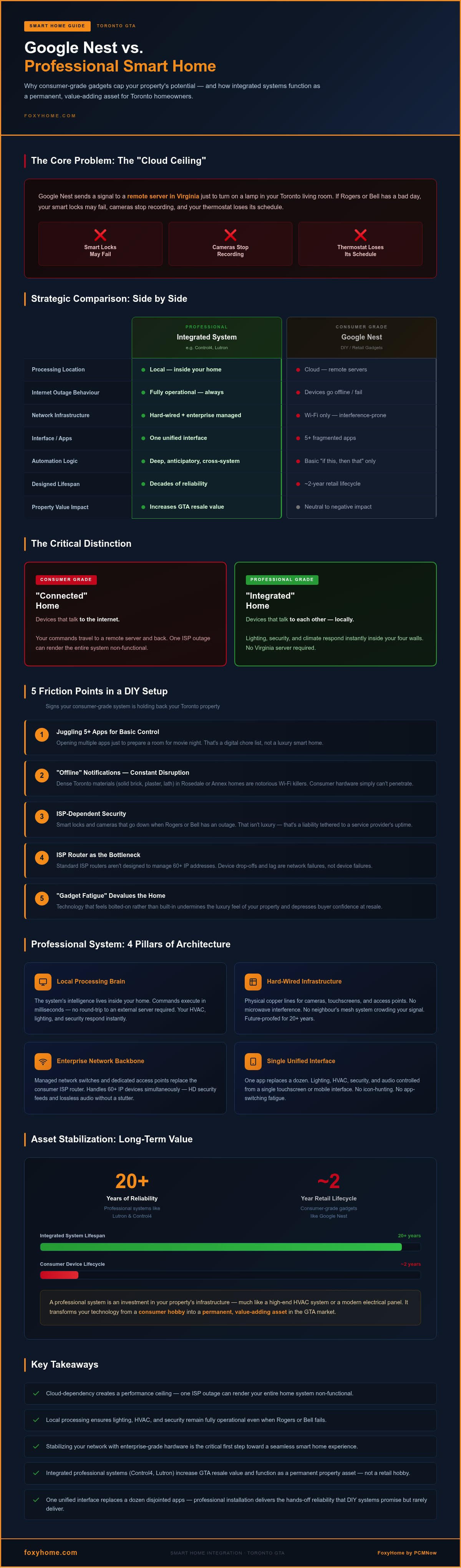
Google Nest is the gateway drug of the smart home world. It's accessible, slickly branded, and easy to grab at a big-box retailer. But for a high-value Toronto property, it represents a ceiling, not a foundation. Most owners eventually hit what we call the "Cloud Ceiling." This is the frustrating moment you realize your home's intelligence is entirely dependent on a remote server. If Rogers or Bell has a bad day, your smart locks might fail, your cameras stop recording, and your thermostat loses its schedule. That isn't luxury; it's a liability that tethers your comfort to a service provider's uptime.
Beyond the cloud, there's the gritty reality of GTA real estate. Many premium homes in neighbourhoods like Rosedale or the Annex are built with dense materials like solid brick, plaster, and lath. These are notorious Wi-Fi killers. Consumer-grade hardware, which relies almost exclusively on wireless signals, struggles to penetrate these barriers. The result is a fragmented mess of "offline" notifications and laggy responses. When you finally decide to upgrade from Google Nest to integrated smart home standards, you move away from these wireless toys and toward a hard-wired professional ecosystem designed to handle the physical complexities of urban architecture.
The DIY Trap: When Convenience Becomes Friction
Are you managing your home, or is your home managing you? If you have to open three different apps just to prepare the living room for a movie, you don't have a smart home; you have a digital chore list. Nest offers simple "if this, then that" triggers, but it lacks the deep logic required for a truly seamless environment. This fragmentation creates "gadget fatigue." It devalues the luxury feel of your home because the technology feels like a bolted-on afterthought rather than a built-in feature. True integration means your home anticipates your needs without you hunting for an icon on your phone.
Asset Stabilization vs. Consumer Hobby
We need to talk about asset stabilization. A professional system is an investment in your property's infrastructure, much like a high-end HVAC system or a modern electrical panel. Systems like Lutron or Control4 are designed for decades of reliability, not a two-year retail lifecycle. There is a fundamental difference between a "connected" home and an "integrated" one. A connected home has devices that talk to the internet. An integrated home has devices that talk to each other locally. This local-first architecture ensures that your lights, security, and climate control work perfectly every time, regardless of your internet connection. It transforms your technology from a consumer hobby into a permanent, value-adding asset.
The Architecture of a Professional Integrated System
A professional system isn't just a collection of apps; it's a hard-wired ecosystem that treats your property like a high-performance machine. When you decide to upgrade from Google Nest to integrated smart home infrastructure, you're investing in local processing. Most DIY gadgets send a signal to a server in Virginia just to turn on a lamp in your Toronto living room. That's inefficient and risky. A professional setup keeps the "brain" inside your house. Your lights, locks, and climate control respond instantly because the data never leaves your four walls. This local-first approach is what separates a reliable asset from a digital toy.
Hard-wiring is the ultimate insurance policy for your property value. While Wi-Fi is convenient for your phone, it shouldn't be the primary carrier for your security cameras or wall-mounted touchscreens. Copper doesn't get interference from the microwave or your neighbour's new mesh system. By pulling physical lines during a renovation or retrofit, we stabilize your tech stack for the next twenty years. It's the difference between a temporary fix and a permanent architectural standard that future-proofs your home against the ever-increasing bandwidth demands of modern life.
The Network Backbone: The Unfiltered Truth
Your standard ISP router is the primary enemy of a functional smart home. These consumer boxes are designed for basic browsing, not for managing sixty different IP addresses simultaneously. When devices "drop off" or lag, it's rarely the device's fault; it's the network choking under the pressure. We replace that bottleneck with enterprise-grade managed network switches and dedicated access points. This creates a robust "pipe" that can handle high-definition security feeds and lossless audio without a stutter. At FoxyHome, we build robust Wi-Fi networking as the system backbone, ensuring your hardware stays online regardless of how many neighbours are clogging the local spectrum.
Single-App Integration: Eliminating the Friction
Imagine Maria and Joe. In their old Nest setup, they spent five minutes every night checking three different apps to ensure the back door was locked, the heat was down, and the porch lights were on. After their upgrade from Google Nest to integrated smart home standards, they tap one "Goodnight" button. The motorized shades lower, the high-end HVAC drops to 18 degrees, and the security system arms. This isn't just about convenience; it's about reclaiming your time. Professional configuration means your home finally delivers on the "hands-off" promise that DIY gadgets only pretend to offer. By unifying your custom window treatments and complex climate zones into a single, reliable interface, you eliminate the mental load of home management.
Google Nest vs. Integrated Pro Systems: A Strategic Analysis
Google Nest is built for the mass market, meaning it's designed to be "good enough" for the average user. But for a sophisticated Toronto property owner, "good enough" is a recipe for technical debt. The strategic difference lies in scalability and resilience. While a Nest setup might handle ten devices with relative ease, it begins to choke when you add the fifty or one hundred endpoints required for a true luxury experience. When you upgrade from Google Nest to integrated smart home standards, you're shifting from a system that fights for Wi-Fi bandwidth to one that utilizes dedicated communication protocols. This ensures your smart shades don't lag just because your teenager started a 4K stream in the basement.
The financial argument for professional integration is equally compelling. In the competitive GTA real estate market, savvy buyers look past the "smart" label. They distinguish between a house full of glued-on retail gadgets and a property with a hard-wired, enterprise-grade foundation. A professional system is a permanent fixture that stabilizes your asset. It suggests a level of care and investment that DIY pucks simply cannot match. It’s the difference between selling a house with a portable space heater versus one with a custom-engineered HVAC system.
The Security Gap: Protecting Your Equity
DIY security is essentially a notification hobby. If a Nest camera detects an intruder at 3:00 AM, it sends a push notification to your phone. If your phone is on "Do Not Disturb," the event goes unnoticed until morning. Professional integration closes this gap by connecting your perimeter sensors and PoE (Power over Ethernet) cameras to a 24/7 monitoring station. PoE is critical here; it provides power and data over a single cable, eliminating the battery failures and Wi-Fi interference that plague retail cameras. FoxyHome focuses on residential security and asset stabilization, ensuring your cameras are a reliable record, not just a series of "connection lost" alerts.
Design Aesthetics and Property Value
Luxury is often defined by what you don't see. Nest devices are visible, plastic, and often clash with high-end interior design. They contribute to "wall acne," where a thermostat, light switch, and alarm panel all fight for space. Integrated systems replace this clutter with architectural-grade keypads and hidden sensors. These interfaces are customized to match your home's finish, providing a clean, unified look that appeals to high-net-worth buyers. Toronto appraisers recognize this as a "Smart Ready" home, a designation that commands a premium because the difficult work of networking and integration is already managed.
The Upgrade Path: Transitioning Your Toronto Home
Transitioning your property from a collection of retail pucks to a professional ecosystem requires a strategic roadmap, not a sledgehammer. You don't necessarily need to bin every Google device on day one. Instead, we focus on a phased migration that prioritizes infrastructure over gadgets. When you begin the upgrade from Google Nest to integrated smart home standards, the first goal is to stop the bleeding. We audit your current friction points, identifying exactly where the DIY logic fails, whether it's a camera that misses the courier or a thermostat that ignores your schedule.
This is the "pipes before water" philosophy. Most homeowners keep adding "water" (more devices) without realizing their "pipes" (the network) are already bursting. A hybrid phase allows you to keep your favourite Nest interfaces while we swap out the consumer-grade router for a professional backbone. This ensures the transition is seamless and minimizes the downtime that usually plagues DIY overhauls. We map the automation logic to your specific GTA lifestyle, ensuring the technology serves your routine rather than dictating it.
Step 1: The Network Audit
Toronto's architectural legacy is a nightmare for Wi-Fi. Solid brick, plaster, and lath act as signal shields that create massive dead zones in premium homes from Rosedale to High Park. We start by mapping these interference points and planning for hard-wired data drops in high-traffic areas like the home office and media room. Network Latency is the millisecond delay between you tapping a screen and a light turning on, a lag usually caused by over-congested consumer frequencies that professional networking completely eliminates. By fixing the latency, we make your home feel responsive again.
Step 2: Selecting Your Integration Platform
The final step is choosing a brain that can actually handle the complexity of your lifestyle. Whether we deploy Control4, Savant, or a customized FoxyHome build, the goal is to bridge your existing gear into a unified interface. This prevents "DIY debt," which is the hidden cost of buying gadgets that won't talk to your next major investment. A professional design consultation ensures your automation logic is mapped to how you actually move through your house. If you're ready to stop troubleshooting and start living, book your professional design and configuration to ensure a friction-free transition.
Executing the Vision with FoxyHome
Realizing the dream of a friction-free residence requires more than a credit card and a free weekend; it requires an engineering partner who understands the high stakes of Toronto real estate. Professional installation is the ultimate hands-off investment for owners who value their time as much as their equity. We don't just "install" devices. We engineer environments. When you choose to upgrade from Google Nest to integrated smart home standards with FoxyHome, you're hiring a team that is battle-hardened by the unique challenges of GTA architecture. We navigate the labyrinth of local building codes and the physical resistance of century-old masonry so you can focus on your legacy, not your Wi-Fi signal.
A smart home is a living system, not a static purchase. It requires an ongoing support model that treats your technology like the critical infrastructure it is. We provide the long-term partnership necessary to keep your system stabilized as new protocols emerge and security threats evolve. This commitment transforms your property from a potential financial burden of outdated gadgets into a strategic advantage. By offloading the technical intensity to experts, you ensure your home remains a high-performance asset that commands attention in a competitive market.
The FoxyHome Difference: Expert Mentors, Not Just Installers
Our approach is rooted in radical transparency and a blunt refusal to accept the inefficiencies of the retail market. We act as expert mentors, guiding you through the "gritty" industry work that DIY tutorials conveniently ignore. Consider a recent multi-plex conversion we managed in West Queen West. The owner was drowning in "DIY chaos," managing six different Google accounts and a dozen disjointed apps for a single building. We stripped out the fragments and deployed a unified, professional backbone. The result was a stabilized asset with increased rental appeal and a single interface that actually worked. We handle the complexity so the user experience remains simple.
Your Next Move: Securing Your Legacy
The Toronto market doesn't wait for late adopters. Modernizing your home infrastructure is no longer a luxury; it's a requirement for maintaining property value in a city that prizes efficiency and security. Don't let a collection of plastic DIY gadgets cap your property's potential or your net worth. The transition to a professional standard is the final step in graduating from a "connected" house to a truly intelligent home. If you're ready to stabilize your asset and eliminate the friction of fragmented apps, book your smart home design consultation with FoxyHome. It's time to build a home that works as hard as you do.
Take Control of Your Property's Digital Backbone
Stop settling for a house that glitches when the internet flickers. You now understand that a true Toronto asset requires more than retail pucks; it demands a local-first architecture and a robust network backbone that eliminates app fatigue. By shifting from a consumer hobby to professional integration, you stabilize your property's value and ensure your security is hard-wired for 24/7 reliability. This isn't just about convenience; it's about protecting your equity and reclaiming your time.
The choice to upgrade from Google Nest to integrated smart home technology is a strategic move toward long-term financial empowerment. You don't have to navigate the technical intensity of Toronto's unique building challenges alone. Our Toronto local installation team and professional smart home design experts are ready to deploy enterprise-grade networking solutions that work for you. We handle the gritty industry work so you can enjoy a seamless, hands-off experience.
Scale your lifestyle and net worth—book a FoxyHome consultation today. Your home should be a source of comfort and security, not a constant troubleshooting project. You've done the research; now it's time to build your legacy.
Frequently Asked Questions
Can I still use my Google Nest cameras with a professional integrated system?
Yes, you can often bridge your existing Nest cameras into a professional system, but they will never achieve enterprise-grade reliability. While we can integrate them for a unified view, they still suffer from the latency and cloud-dependency inherent to DIY hardware. We usually recommend transitioning critical perimeter surveillance to Power over Ethernet (PoE) hardware to ensure your security records locally even if your Wi-Fi signal drops.
How much does it cost to upgrade from a DIY setup to an integrated smart home in Toronto?
The cost to upgrade from Google Nest to integrated smart home standards depends entirely on the scale of your Toronto property and the complexity of your existing wiring. Rather than a one-off purchase, this is a strategic investment in asset stabilization. You are moving away from retail gadgets and toward a permanent architectural feature. We focus on building a robust network backbone first to ensure your capital isn't wasted on unreliable hardware.
Do I need to rewire my entire house to move away from a Wi-Fi-based system?
You don't always need to tear open every wall to move away from a Wi-Fi-based system. Modern retrofitting techniques allow us to pull data lines to critical locations without major structural disruption. While we prioritize hard-wiring for security and high-bandwidth areas, we can use professional-grade wireless protocols for less critical endpoints. The goal is to eliminate the interference common in dense GTA neighbourhoods without turning your home into a construction site.
What happens to my smart home if the internet goes down in the GTA?
Your home continues to function because professional systems utilize local processing instead of relying on a remote cloud server. If Rogers or Bell goes offline in the GTA, your lights will still turn on, your shades will move, and your security sensors will trigger. Unlike a DIY setup that becomes a collection of expensive paperweights during an outage, an integrated system keeps the brain of your home inside your four walls.
Is a professional smart home system really worth the investment for property resale?
A professional smart home system significantly impacts property appraisals in the competitive Toronto market. Savant or Control4 installations are viewed as permanent upgrades, much like custom cabinetry or high-end appliances. Buyers in neighbourhoods like Forest Hill or Yorkville expect a Smart Ready foundation. They value the fact that the difficult work of networking and integration is already managed, allowing for a turnkey luxury experience.
How long does a typical professional smart home installation take in Toronto?
A typical professional installation in Toronto can range from a few days for a condo to several weeks for a full-scale residential estate. The timeline depends on whether we are performing a clean-slate install or a complex retrofit of an older building. We prioritize a seamless cutover to minimize your downtime. Our team manages the logistics and bureaucracy, ensuring the transition from DIY chaos to integrated bliss is handled efficiently.
Can FoxyHome integrate my existing smart lighting with a new security system?
FoxyHome specializes in unifying disjointed systems into a single, reliable interface. We can often bridge your existing smart lighting with a new, professionally monitored security system to create powerful automation logic. For example, your lights can automatically flash if a perimeter alarm is triggered at night. This level of cross-platform communication is exactly why homeowners choose to upgrade from Google Nest to integrated smart home environments that prioritize security and comfort.
What is the difference between an 'integrated' home and a 'connected' home?
A connected home is a collection of individual gadgets that you control through separate apps on your phone. An integrated home is a unified ecosystem where every device talks to a central local controller. Connected homes are fragile and dependent on the cloud; integrated homes are robust and function autonomously. Integration removes the friction of switching between apps, providing a single interface that manages your entire property's climate, lighting, and security.


Comments