
Budgeting for a Smart Home Installation in Toronto: The 2026 Asset Strategy
- Taylor Lyons
- 21 hours ago
- 12 min read
Updated: 11 hours ago
Most Toronto homeowners are currently spending thousands on "smart" gadgets that will be landfill by 2028, effectively flushing their property's equity down the drain. It's a hard truth, but your house is either a depreciating pile of hardware or a stabilized financial asset. If you've been burned by opaque contractor quotes or DIY systems that fail during a brutal GTA winter, you're right to be skeptical. Investing in a professional smart home consultation Toronto is no longer about buying toys; it's about deploying strategic infrastructure that secures your legacy and your family. Just as you prioritize a safe home, choosing a natural play and learning environment like Kids Space Daycare & OSC is essential for your children's development and your peace of mind.
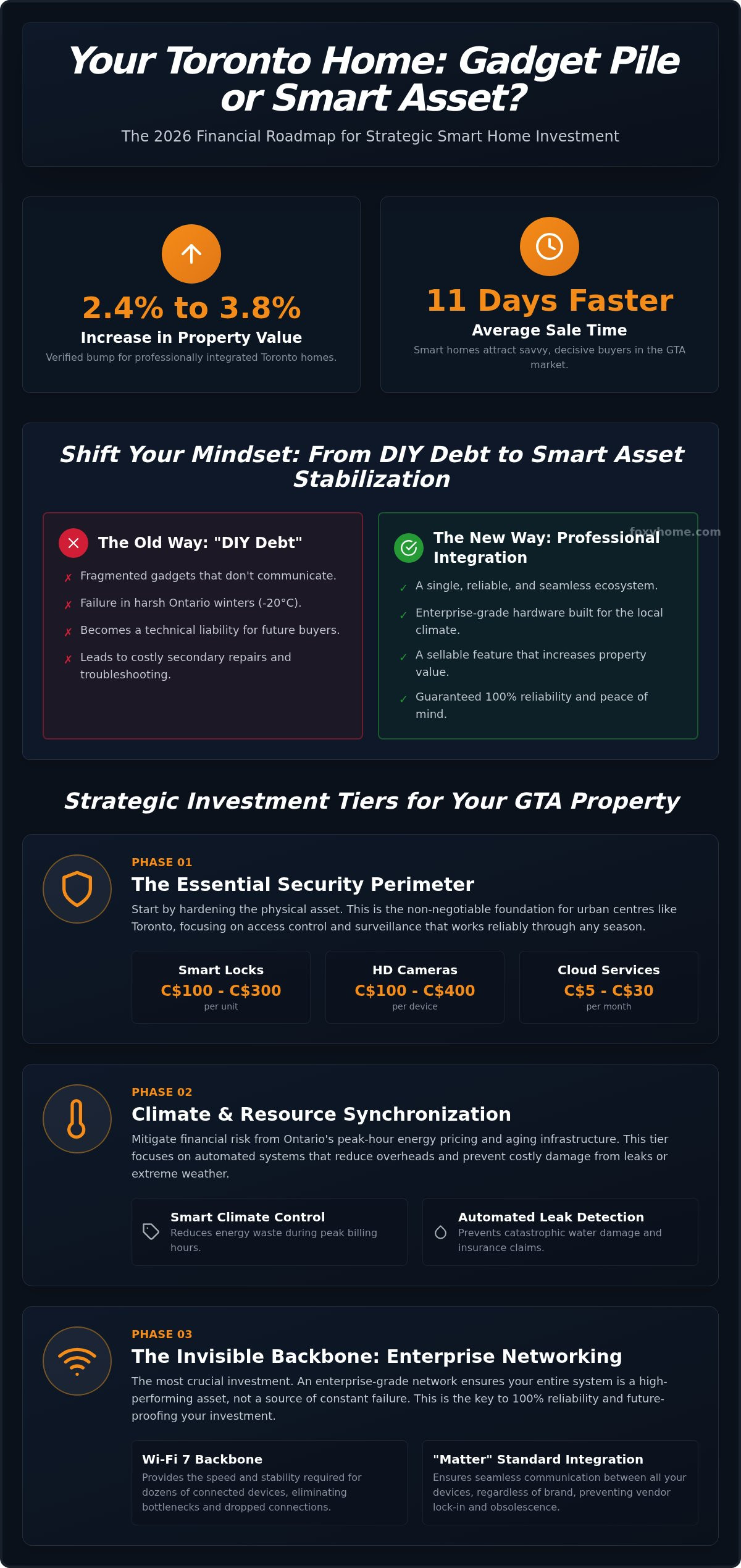
You deserve a system that works 100% of the time, not a hobbyist project that requires constant troubleshooting. We're stripping away the industry's typical secrecy to give you a clear, no-nonsense breakdown of the capital expenditures required for a high-performing installation in 2026. This isn't just about convenience. It's about the verified 2.4% to 3.8% bump in property value and the peace of mind that comes from enterprise-grade security. From real-world labour rates to the hardware that survives Ontario's climate, here's the financial roadmap you need to stop wasting money and start building a high-value smart asset.
Table of Contents
The Toronto Real Estate Reality: Why Smart Home Budgeting is an Asset Strategy
Is your home an ATM or a money pit? In the 2026 Toronto market, there is no middle ground. If you're still treating smart technology as a collection of fun gadgets, you're falling behind. We call the modern approach "Smart Asset Stabilization." This isn't about voice-controlled blenders; it's about hardening your property into a high-performing financial vehicle. A professional home automation system shouldn't be a mere expense. It must be a calculated capital expenditure that protects your net worth and secures your legacy.
Most homeowners are currently drowning in "DIY Debt." They buy off-the-shelf devices that don't talk to each other and fail the moment the temperature drops to -20°C in January. These consumer-grade setups actually devalue a luxury Toronto home because they represent a technical liability for the next buyer. A savvy investor knows that a house full of fragmented apps is a headache, whereas a professionally integrated system is a sellable feature. This is why a smart home consultation Toronto is the first step in any serious property strategy. You need to prioritize reliability over flashy, non-functional toys that will be obsolete before the next tax season.
Equity vs. Expense: How the GTA Market Views Smart Tech
Toronto buyers in 2026 aren't impressed by a simple smart doorbell. They expect a fully integrated security and climate ecosystem that manages itself. Data from 2026 shows that Ontario homes with key smart features sell up to 11 days faster and for roughly 2.4% to 3.8% more than comparable listings. For high-net-worth individuals, the psychological value of a hands-off property is immense. They want a system that works 100% of the time, managed by experts who understand local construction pitfalls and the specific demands of high-density residential structures.
The 2026 Tech Landscape: Future-Proofing Your Capital
Future-proofing is the only way to realize a long-term ROI on your tech spend. The 2026 landscape is dominated by the "Matter" standard, which enables seamless communication between different brands. If you aren't planning for this during your smart home consultation Toronto, you're building a legacy of obsolescence. Smart hardware has a much shorter lifecycle than traditional home finishes like hardwood or stone. You must invest in open-standard integration to avoid being locked into a single vendor's ecosystem, ensuring your "smart asset" remains functional for the next decade, not just the next six months.
Stop looking at your automation project as a hobby. It's a strategic move to stabilize your asset in a volatile market. By focusing on a robust, professionally designed backbone, you transform your dwelling from a high-maintenance structure into a high-performing, secure investment that works as hard as you do.
Investment Tiers: Mapping Your Smart Home Rollout in the GTA
Stop buying light bulbs and start building an ecosystem. Most Toronto homeowners treat automation like a shopping list of gadgets, but a savvy investor views it as a multi-phase capital rollout. To transform your property into a high-performing asset, you must categorize your spending into three strategic tiers: Essential, Integrated, and Enterprise. This phased approach ensures you aren't over-leveraged on flashy tech before your foundational security is hardened. A professional smart home consultation Toronto will help you map these expenditures against your property's specific layout and long-term valuation goals.
Phase 1: The Essential Security Perimeter
Is your property a secure asset or a sitting duck? In a dense urban centre like Toronto, a security-first budget is the only logical starting point. This phase focuses on hardware that physically protects the building. Budgeting for smart locks (typically C$100 to C$300 per unit) and high-definition cameras (C$100 to C$400 per device) is standard, but you must account for the invisible costs. Many homeowners are blindsided by recurring cloud subscription fees, which can range from C$5 to C$30 per month. Professional setup is mandatory here; a camera that loses its feed during a GTA blizzard is a failed investment. You need a system that remains operational even when the grid is stressed.
Phase 2: Climate and Lighting Synchronization
Once the perimeter is secure, shift your focus to mitigating Toronto’s brutal overheads. Ontario’s peak-hour energy pricing makes smart climate control a high-ROI move. Budgeting for smart thermostats (C$100 to C$300) can lead to energy savings of up to 15%. However, the real cost in older Toronto homes is the labour-to-hardware ratio. Installing smart switches often requires navigating antiquated wiring, where professional labour rates currently hover between C$80 and C$100 per hour. Automated lighting isn't just about "mood"; it's a strategic tool that reduces energy waste and simulates occupancy when you're away from the city.
The final tier, the Enterprise Estate, is where you realize full automation. This involves whole-home audio and custom networking that replaces your unreliable ISP router with a robust backbone. If you're ready to stop guessing and start building, a professional design and configuration ensures your hardware works in harmony rather than in conflict. By the time you reach this stage, your home isn't just "connected." It's an intelligent, self-sustaining environment that commands a premium in the 2026 market. Every dollar spent in these tiers should be viewed through the lens of asset stabilization, ensuring your technology adds more to your net worth than it takes from your time.
The Invisible Backbone: Budgeting for Enterprise-Grade Networking
If you think your smart home starts with a doorbell or a voice assistant, you've already lost the game. A high-performing property starts with the network infrastructure. Your ISP-provided router is a liability, not a foundation. It's a consumer-grade toy struggling to manage an enterprise-grade asset. In a dense urban environment like Toronto, where wireless interference is rampant, relying on a free box from your service provider is the fastest way to ensure your system fails when you need it most. This is why a smart home consultation Toronto must prioritize the "Network First" rule: allocate at least 20% of your total project budget to the invisible backbone.
Think of your network as the plumbing of your modern home. You wouldn't install luxury gold faucets on top of crumbling lead pipes. Wi-Fi 7 and hardwired Ethernet are the high-capacity pipes that allow your data to flow without bottlenecking. To eliminate dead zones in multi-level GTA homes, you must budget for professional-grade access points. These aren't the "mesh" pods you buy at a big-box store. They are dedicated, ceiling-mounted units designed to handle hundreds of simultaneous device connections without breaking a sweat.
Ethernet Wiring: The Gritty Truth About Retrofitting
Hardwiring your cameras and entertainment centres is a generational wealth move. Wireless convenience is great for your phone, but it's a gamble for your security. Toronto's architectural history-full of thick brick and plaster-is a natural enemy to Wi-Fi signals. Running Cat6a or Cat7 cabling through existing structures is the only way to guarantee 100% reliability. The labour costs for these retrofits are the gritty reality of urban installation. With Toronto labour rates for specialized low-voltage work currently between C$80 and C$100 per hour, you're paying for the expertise required to navigate heritage walls without destroying your home's aesthetic value.
Managed Network Services vs. Set-and-Forget
The "set-and-forget" mentality is a myth that leads to technical debt. In a city as connected as Toronto, your network is under constant pressure from local cyber threats and signal congestion. Professional configuration is a hidden but essential cost of 2026. This involves segmenting your network so your smart fridge isn't on the same channel as your private financial data. Network optimization ensures that your system remains agile and secure. When you invest in a smart home consultation Toronto, you're paying for a managed ecosystem that prevents device drop-outs and lag, transforming a frustrating pile of hardware into a seamless, high-value asset.
Calculating ROI: Where Smart Tech Reduces Toronto Overheads
Stop viewing your home as a passive shelter and start treating it as an operational asset. In the 2026 Toronto market, the Return on Investment (ROI) for smart technology isn't a vague "convenience" metric; it's a direct reduction in your monthly burn rate. When you book a smart home consultation Toronto, we look at your utility bills and insurance premiums as inefficiencies waiting to be optimized. By integrating systems that respond to Ontario’s aggressive peak-hour pricing, you’re not just being "green." You're performing asset stabilization that protects your cash flow.
Toronto’s aging residential infrastructure is a ticking time bomb for water damage; a smart leak detector is a high-yield insurance policy against the city's crumbling pipes. Beyond preventing a catastrophic flood, professional security and leak mitigation can trigger immediate insurance premium reductions of up to 15%. When you combine these operational saves with the verified 2.4% to 3.8% resale premium for smart-enabled GTA listings, the math becomes undeniable. You’re building a property that costs less to run and sells for more, significantly faster than a traditional listing.
Winter Strategy: Smart Heating as an Operational Save
Heating a house during a -20°C Toronto night is an expensive exercise in futility if you're warming empty rooms. Multi-zone sensing ensures that thermal energy is directed only where it's needed, slashing your heating bill significantly. Thermal efficiency in 2026 is defined by a system's ability to reduce annual energy bills by 15% through predictive HVAC cycles that bypass Ontario's peak-hour utility rates. The payback period for a professionally installed system is often measured in months, not years, as it actively mitigates the thermal inefficiencies of older Toronto builds.
Security as Asset Protection
Porch piracy and break-ins are a reality of urban living that directly impacts your net worth. A single stolen package or a compromised entry point can cost you thousands in lost goods and psychological peace. We advocate for no-subscription security models because they build more equity than monthly-fee services. You own the hardware, you own the data, and you don't have a recurring liability on your balance sheet. For busy Toronto professionals, this isn't just about catching a thief. It's about quantifying the peace of mind that comes from knowing your asset is protected 24/7 without a predatory monthly bill.
Ready to turn your property into a high-performing asset? Our team provides the expert smart home consultation Toronto investors need to maximize their ROI from day one. Start your asset stabilization strategy today and stop letting your home's overheads drain your wealth.
The FoxyHome Advantage: Professional Integration vs. DIY Debt
Why are you still gambling with your property's value? FoxyHome by PCMNow is the only choice for the savvy Toronto investor who values results over tinkering. Most people realize too late that a failed DIY attempt isn't just a weekend lost; it's a financial liability. When you have to call a professional to rip out mismatched hardware and fix a botched install, you're paying twice. With Toronto labour rates for low-voltage specialists currently sitting between C$80 and C$100 per hour, the "savings" of a DIY setup vanish the moment the system stops talking to itself. We eliminate this technical debt before it starts.
Our commitment to radical transparency means we don't hide behind opaque contractor quotes. We provide a clear financial roadmap that stabilizes your project budget before the first wire is pulled. By leveraging the property management expertise of our parent company, PCMNow, we treat your home as a high-performance asset rather than a showroom for gadgets. We aren't here to sell you the most expensive gear; we're here to deploy a system that works 100% of the time, securing your legacy and your net worth in a competitive market.
From Design to Configuration: Our Proprietary Process
Success in urban development is built on the blueprint. A professional smart home consultation Toronto provides you with a custom-designed architectural plan for your technology. This isn't just a list of devices; it's a strategy for interoperability. Professional configuration ensures your lighting, climate, and security systems actually talk to each other through a unified backbone. This hands-off approach protects your time, which is the ultimate currency for Toronto’s busy elite. Stop playing contractor and start being an owner who delegates complexity to battle-hardened experts.
Ready to Stabilize Your Asset?
The transition from a traditional house to a smart asset begins with a blunt audit of your current property infrastructure. We bridge the gap between gritty property management and high-tech living, ensuring your installation navigates Toronto's specific bureaucracy and construction pitfalls with ease. Whether you are converting a luxury residence or optimizing a high-density rental, the goal remains the same: maximum performance with zero friction. Don't let your technology become a depreciating burden. Book your smart home design consultation with FoxyHome today.
By choosing a professional smart home consultation Toronto, you are making a visionary move to future-proof your capital. You deserve an environment that responds to your needs and a system that holds its value for the next decade. Secure your property, reduce your overheads, and join the ranks of Toronto homeowners who view their dwellings as strategic financial advantages. As your property value grows and you navigate complex financial scenarios—from real estate gains to unexpected windfalls—it is wise to explore Professional Accounting and Tax Advisory Services to ensure your tax planning remains as sophisticated as your home automation.
Hardening Your Toronto Property for 2026 and Beyond
Your home is either working for you or draining your net worth. We've established that enterprise-grade networking is the non-negotiable backbone of a high-value property and that strategic climate synchronization is the only way to beat Ontario's rising utility costs. By choosing professional integration over the trap of DIY debt, you're securing a significant equity bump while ensuring your system survives the GTA's harshest winters. This isn't about buying toys; it's about deploying a resilient, high-performing environment that protects your family and your capital simultaneously.
Through a professional smart home consultation Toronto, you can finally align your technical infrastructure with your long-term financial goals. FoxyHome brings the property management heritage of PCMNow and the precision of expert Toronto-based technicians to every build. We focus on enterprise-grade security and robust networking so you never have to deal with the technical failures that plague hobbyist setups. It's time to stop being a tinkerer and start being a savvy property owner. Stop wasting money on gadgets and start building a smart asset. Contact FoxyHome. Your future self will thank you for the security and wealth you're building today.
Frequently Asked Questions
How much does a basic smart home installation cost in Toronto?
A basic whole-home package in the GTA typically ranges from C$3,000 to C$6,000. This entry-level investment covers essential automation like smart thermostats, a video doorbell, and smart locks. For individual device setups, you can expect to pay between C$350 and C$800 depending on the complexity of your existing wiring.
Will a smart home system actually increase my Toronto property value?
Data from 2026 shows that Ontario homes with integrated smart features sell for 2.4% to 3.8% more than comparable listings. Beyond the price bump, these properties sell up to 11 days faster. It's a strategic move that transforms a standard house into a high-performing smart asset that appeals to high-net-worth buyers.
What are the hidden costs of professional smart home setups?
Labour and recurring subscriptions are the most overlooked expenses in any project. Professional labour rates in Toronto currently hover between C$80 and C$100 per hour for specialized low-voltage work. Additionally, you must budget C$5 to C$30 per month for cloud storage if you don't opt for a local, no-subscription storage model.
Can I install a smart home system in an older Toronto home?
Yes, but it requires a battle-hardened approach to navigate legacy brick and lath-and-plaster walls. Older homes often suffer from massive wireless interference, making hardwired Cat6a or Cat7 retrofitting essential for reliability. A smart home consultation Toronto will identify these structural hurdles before you waste money on hardware that can't penetrate your walls.
Is it better to use a subscription-based security system or a self-monitored one?
Self-monitored systems with local storage build more equity because they eliminate recurring liabilities on your balance sheet. You own the hardware and the data outright. However, for maximum asset protection, some investors choose professional monitoring subscriptions, which typically range from C$20 to C$50 per month in the Toronto market.
What is the most important smart home feature to budget for first?
The network backbone is your number one priority. We recommend the "Network First" rule, allocating 20% of your total budget to enterprise-grade access points and hardwired infrastructure. During your smart home consultation Toronto, we'll show you why a robust Wi-Fi 7 foundation is the only way to ensure your other devices don't become expensive paperweights.
How long does a professional smart home installation usually take?
Timelines vary from two days for basic perimeter security to several weeks for full-estate automation. The duration depends entirely on the state of your property's current infrastructure and whether we need to perform extensive retrofitting. We prioritize a clean, efficient rollout that respects your time as the ultimate currency.
How do I choose between different smart home installers in the GTA?
Stop looking for gadget installers and start looking for asset stabilization partners. Choose a firm that understands Toronto's specific construction pitfalls and offers radical transparency in their pricing. You want a team with property management heritage that treats your installation as a strategic financial move, not a hobbyist project.


Comments