
Cost to Automate a House in Toronto: A 2026 Asset Valuation Guide
Most Toronto homeowners treat smart technology like a collection of expensive toys, but they're actually bleeding equity through fragmented, obsolete gadgets. If you're looking at the cost to automate a house in Toronto as a simple retail purchase, you've already lost the financial game. It's not about how many voice-activated light bulbs you can cram into a West End semi; it's about strategic asset stabilization. By 2026, a home that isn't intelligently integrated isn't just "old school," it's a financial liability that's harder to sell and more expensive to maintain.
You're likely exhausted by "app fatigue" and the nagging fear that your hardware will be obsolete before the next tax season. We agree that the traditional market is a predatory mess of hidden subscription fees and incompatible devices. This guide will strip away the marketing fluff to reveal the blunt truth about smart home investment tiers and how to calculate the real ROI of your property's tech stack. We'll break down the 2026 budget frameworks, explain how the Matter standard finally ends the device wars, and show you how to build a hands-off system that actually increases your property equity.
Table of Contents
The Real Cost of Smart Home Automation in the GTA
Most online "cost guides" are functionally useless for property owners in the 416 and 905. They quote national averages that might buy you a handful of cameras and a smart doorbell, but they don't reflect the reality of a functional ecosystem. When you calculate the actual cost to automate a house in Toronto, you have to account for the "Toronto Premium." This isn't just a simple markup; it's a reflection of our high-density urban environment, complex housing stock, and the specialized labour required to navigate them both.
The "Gadget" vs. "System" Distinction
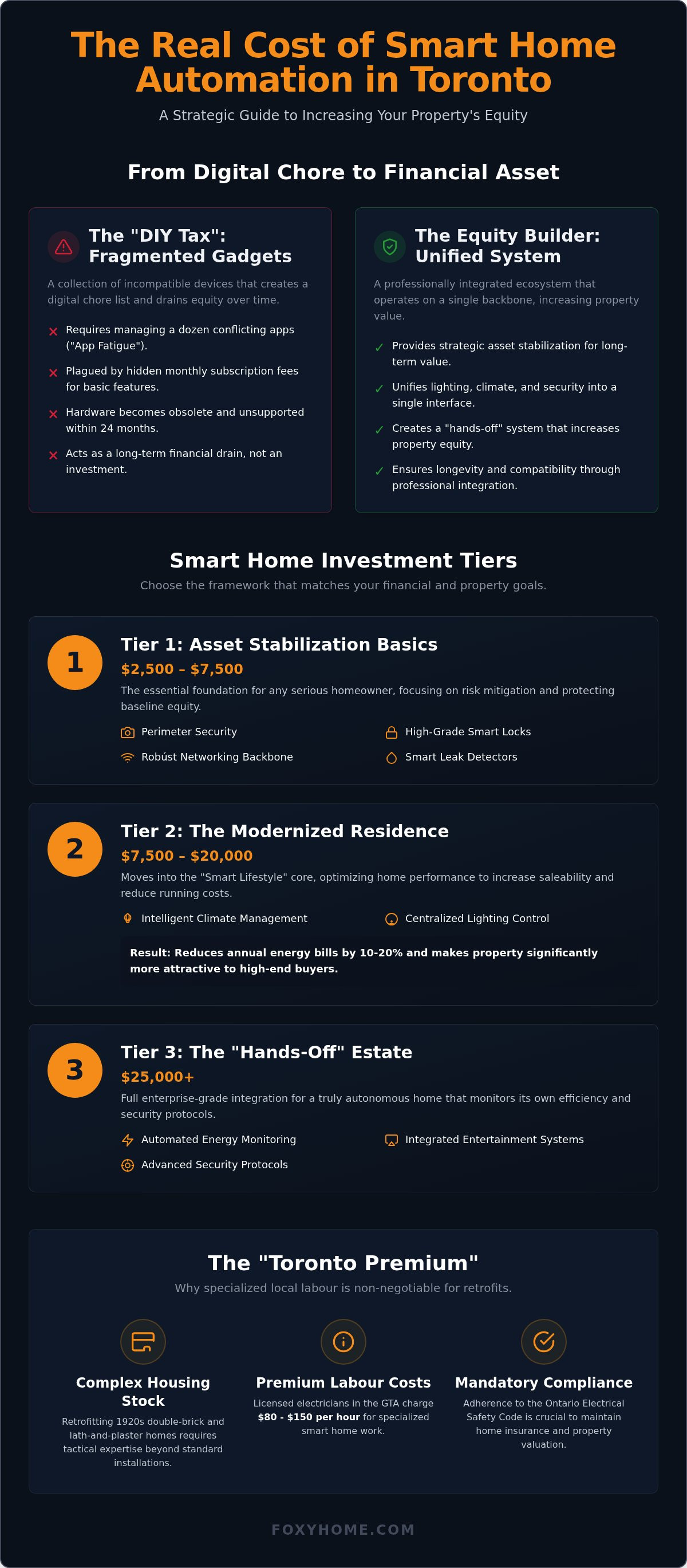
A $50 smart bulb is a retail gimmick, not a property upgrade. If your "automation" requires opening six different apps just to dim the lights and set the alarm, you don't have a smart home; you have a digital chore list. True home automation system integration means your property operates on a single, unified backbone where devices communicate without your intervention. Systemic automation is the seamless integration of lighting, climate, and security into a single, high-performance backbone. Fragmented DIY devices are a financial drain because they lack interoperability and often require hidden monthly subscriptions just to keep basic features active. Over time, the "DIY Tax" adds up as you're forced to replace cheap, unsupported hardware every 24 months.
Toronto Market Realities in 2026
Why does it cost more to build a smart home here? First, look at the housing stock. Running enterprise-grade networking through a 1920s High Park semi-detached with double-brick walls and lath-and-plaster ceilings is a tactical nightmare compared to a new build in the suburbs. Second, specialized labour in the GTA is at a premium. In 2026, hiring a licensed electrician for smart home installation in Toronto typically costs between $80 and $150 per hour. You aren't just paying for the wire; you're paying for the expertise to ensure your system complies with the Ontario Electrical Safety Code. This compliance is mandatory to maintain your home insurance coverage and protect your asset's valuation.
A professional entry-level system focuses on core stability: networking, security, and climate control that works every time. Full enterprise integration moves beyond that, creating a "hands-off" environment where the house monitors its own energy efficiency and security protocols. If you're serious about your property as an investment, you need to stop buying gadgets and start investing in infrastructure that stabilizes your net worth.
Tiered Investment Levels: From Security to Whole-Home Integration
Stop looking for a single, magic number. The Canada Smart Home Market size is expanding rapidly because savvy investors finally realize that technology is infrastructure, not an accessory. When you calculate the cost to automate a house in Toronto, you need to choose a tier that matches your financial goals. Whether you're stabilizing a rental property or future-proofing a luxury estate, your budget should reflect the complexity of the "hands-off" experience you want to create.
Tier 1: Asset Stabilization Basics ($2,500 – $7,500)
This is the minimum viable product for any serious Toronto landlord or homeowner. We focus on perimeter security, high-grade smart locks, and a robust networking backbone. It's about risk mitigation. A smart leak detector or a remote-monitored security system pays for itself the first time it prevents a flooded basement or an unauthorized entry. You're buying peace of mind and protecting your baseline equity. At this level, you're ensuring the property is secure, connected, and manageable from a single interface without the clutter of a dozen different apps.
Tier 2: The Modernized Residence ($7,500 – $20,000)
This tier moves into the "Smart Lifestyle" core. We integrate intelligent climate management and centralized lighting control. With Ontario's utility rates constantly shifting, automated temperature setbacks can reduce annual energy bills by 10 to 20 percent. It's not just about the monthly savings; it's about "saleability." A house that manages its own environment is significantly more attractive to high-end buyers. You're no longer just securing the building. You're optimizing its performance and ensuring it stands out in a competitive GTA real estate market.
Tier 3: The "Hands-Off" Estate ($25,000+)
This is for the property owner who demands zero friction and absolute performance. This tier includes whole-home audio, automated window treatments, and multi-zone climate control that learns your habits. The hardware is "invisible," tucked away to maintain a clean architectural aesthetic while an enterprise-grade network supports 50 or more connected devices simultaneously. It's high-density performance without the visual noise. This level of integration transforms a house into a strategic tool for wealth and comfort. If you're ready to stop guessing and start building an integrated legacy, consult with a professional integrator to map out your specific requirements.
Why "Cheap" DIY Solutions Are a Financial Liability
The allure of a low upfront cost to automate a house in Toronto via retail big-box stores is a trap. You think you're saving money by picking up a few "smart" gadgets on sale, but you're actually inviting technical debt that will eventually default. Consumer-grade Wi-Fi routers are designed to handle a couple of laptops and a few phones; they aren't built to manage the persistent, high-density traffic of 40 or 50 smart devices. When the network chokes, your "smart" home becomes a dumb house that requires constant reboots and manual resets. This isn't innovation; it's a part-time job you didn't apply for.
Then there's the "App Fatigue" problem. Managing 12 different logins and hunting through folders on your phone just to adjust the thermostat and check the front door is a productivity killer. It's the opposite of the "hands-off" lifestyle professional integration promises. Professional configuration is the only antidote to this constant troubleshooting loop. It moves your property away from a collection of apps and toward a unified, reliable infrastructure.
The Security Vulnerability of Retail Gear
Cheap retail cameras often rely on "free" or low-cost cloud subscriptions that prioritize manufacturer data-mining over your integrity. These devices frequently become entry points for hackers because they lack robust, local encryption and rely on outdated firmware. There's also a massive difference between "notified" security, where your phone pings you while you're in a meeting, and "monitored" protection that actually triggers a professional response. We prioritize local, encrypted processing because your private life shouldn't be stored on a vulnerable server in another country just to save a few dollars on hardware.
The Real Cost of Maintenance
When a DIY light switch stops responding at 10 PM on a Tuesday, who do you call? There's no help desk for a fragmented system you built yourself during a weekend binge. The value of a professional warranty and local technician support cannot be overstated. You're paying for a system that works, not a hobby that requires weekly maintenance. Enterprise-grade hardware eliminates the "DIY tax" by providing a decade of reliable service compared to the two-year lifespan of most retail gadgets. If you want to stabilize your asset, you have to stop thinking like a consumer and start thinking like an investor.
Planning Your Infrastructure: The Hidden Variables of Toronto Retrofits
Infrastructure is the unglamorous foundation of any high-yield property upgrade. If you ignore the bones of the building, your investment is a house of cards. Calculating the cost to automate a house in Toronto requires a cold, hard look at your home's current capacity to support enterprise-grade technology. You have to look past the gadgets and assess the hidden variables that either stabilize your asset or turn it into a money pit.
Step one is the network audit. Your current ISP router is a consumer-grade toy. It's functionally junk for a professional ecosystem. It will buckle under the traffic of simultaneous security feeds, climate sensors, and lighting controls. You need a dedicated "brain" centre, usually a centralized equipment rack, to manage the load. Then there's the electrical reality. Many older Toronto homes require an electrical panel upgrade, which typically costs between $2,500 and $4,500, to handle the increased load and ensure compliance with the Ontario Electrical Safety Code. Without this assessment, you're just building on a shaky foundation.
Retrofitting Older GTA Homes
Toronto's housing stock is a minefield of architectural complexity. The challenges of an Etobicoke estate are vastly different from a downtown Victorian semi-detached. Solid brick and lath-and-plaster walls are notorious for killing Wi-Fi signals. Hiding wires in heritage properties without destroying the original aesthetic is a specialized skill. It adds to the cost of difficult installs. You aren't just paying for hardware. You're paying for the surgical precision required to integrate it into a 100-year-old structure.
The Networking Backbone
Despite the hype around wireless, Ethernet wiring remains the undisputed king of reliability in 2026. A strategic layout of wired Access Points ensures 100% coverage with zero dead zones, regardless of how much double-brick stands in the way. This is how you future-proof your asset for the next decade of connectivity. If you want to stop fighting your hardware and start reaping the rewards of a stabilized property, book a professional infrastructure audit to see what your home actually needs.
FoxyHome: Professional Integration That Stabilizes Your Property Value
FoxyHome doesn't play the retail game. We aren't here to sell you a bag of plastic gadgets that will be in a landfill by 2028. When you calculate the cost to automate a house in Toronto, you're choosing between a collection of toys and a strategic financial asset. We build the latter. Backed by the PCMNow legacy, we bring enterprise-grade property management standards directly into your residential space. This isn't just about convenience; it's about transforming your property from a high-maintenance burden into a streamlined, high-performance tool for generational wealth.
Our "Single App" promise is the core of our philosophy. We realize you're tired of digital clutter. You don't want to hunt through folders to turn off the kitchen lights or check the perimeter. We provide a unified experience that gives you total control without the technical headache. It's a "hands-off" system that actually works, allowing you to focus on your life while we manage the infrastructure. This professional installation creates a legacy of security for your family, ensuring your home remains a safe, efficient sanctuary for decades.
The FoxyHome Process
We begin with a comprehensive audit of your property's existing infrastructure. Our technicians are battle-hardened experts who have navigated the high-stress environments of Toronto bureaucracy and construction pitfalls. We don't just plug things in; we design, configure, and provide the user training necessary to ensure you're the master of your domain. From hiding wires in historic Annex masonry to optimizing networks in glass-walled condos, we handle the complexity. You simply enjoy the results. We take the stress out of the integration, providing a proprietary process that competitors can't match.
Secure Your Equity Today
Waiting to automate is a choice to keep losing money. Every month you delay is another month of energy waste and unmanaged security risks. With smart thermostats capable of reducing climate costs by up to 23 percent, the ROI of a professional system is undeniable. High-density, smart-enabled urban living is the future of the GTA, and failing to adapt means watching your property value stagnate while the market moves forward. Stop guessing and start strategizing. It's time to stabilize your asset and build a legacy that lasts. Reach out to FoxyHome today and take command of your home's future.
Stop Reacting and Start Strategizing Your Property Equity
You've seen the blunt truth. Smart home technology isn't a retail hobby; it's a strategic infrastructure upgrade that protects your net worth. Whether you're navigating the complexities of a century-old Annex semi-detached or optimizing a modern glass tower, the cost to automate a house in Toronto is an investment in asset stabilization. By moving away from fragmented DIY gadgets and toward a unified, enterprise-grade backbone, you eliminate the "app fatigue" and technical debt that plague the traditional market.
FoxyHome brings the battle-hardened property management expertise of PCMNow directly to your doorstep. We provide professional design and configuration by expert technicians who understand Toronto’s unique residential landscape. This is your opportunity to build a legacy of security and efficiency that actually increases your property's saleability. Stop guessing at your budget and start building a hands-off system that works as hard as you do.
Secure your Toronto asset with a professional FoxyHome consultation and take the first step toward a high-performance home that serves your future. Your property is a tool for wealth; it's time you used it like one.
Frequently Asked Questions
Is it cheaper to DIY my smart home in Toronto or hire a pro?
DIY setups often look cheaper on paper but result in a fragmented mess of incompatible gadgets. You'll likely pay a "DIY tax" through constant troubleshooting and hardware replacement every 24 months. Professional integration ensures your system complies with the Ontario Electrical Safety Code, which is critical for maintaining home insurance coverage. Hiring an expert technician transforms your property into a stabilized financial asset rather than a high-maintenance hobby that drains your time.
How much does a basic smart security system cost in the GTA?
A standard home security system in Toronto typically ranges from $500 to $2,500, depending on your monitoring requirements and hardware choices. This baseline usually includes smart locks, perimeter cameras, and entry sensors. However, the true cost to automate a house in Toronto involves moving beyond standalone gadgets. Integrated security that communicates with your lighting and climate control provides a significantly higher level of asset protection and long-term property equity.
Will home automation actually increase my property value in Toronto?
Strategic automation increases property value by improving saleability and operational efficiency. Modern buyers in the GTA prioritize homes with "hands-off" climate and security systems that reduce monthly overhead. Smart thermostats alone can lower heating and cooling costs by up to 23 percent, which is a major selling point given rising Ontario utility rates. When you treat technology as infrastructure rather than an accessory, you're building a legacy that high-end investors actively seek.
Can I automate an older home with plaster walls or knob-and-tube wiring?
You can absolutely automate older Toronto homes, but it requires a specialized approach to overcome architectural hurdles. Solid brick and lath-and-plaster walls are notorious for killing wireless signals, often necessitating a wired networking backbone for total reliability. If your property has knob-and-tube wiring, you'll need to prioritize an electrical panel upgrade to meet modern safety standards. Expert technicians specialize in hiding enterprise-grade hardware within heritage aesthetics to ensure your Victorian semi-detached performs like a new build.
What are the ongoing monthly costs for a professional smart home system?
Professional systems prioritize local, encrypted processing to eliminate the "subscription creep" common with retail gear. While some specialized monitoring services or off-site backups may carry a fee, a well-designed ecosystem minimizes these recurring drains. Unlike DIY gadgets that lock basic features behind monthly paywalls, enterprise-grade integration focuses on hardware longevity and local control. This approach ensures your system remains a financial advantage rather than a perpetual subscription burden on your monthly cash flow.
How long does a typical professional smart home installation take?
The duration of a professional installation depends entirely on the scope of your property's integration. A basic security and networking setup might only take a single day, while full enterprise-grade automation for a large estate can span several weeks. This timeline includes the initial infrastructure audit, hardware mounting, custom programming, and user training. We manage the complexity behind the scenes, ensuring the process is "hands-off" for you while we navigate the gritty realities of Toronto construction.
Do I need to upgrade my internet plan for a full home automation system?
Your internet speed is rarely the bottleneck; it's usually your ISP-provided router that fails under the load of a smart home. A professional automation system requires a robust networking backbone to manage dozens of simultaneous device connections. While a high-speed fibre plan is beneficial for 4K security feeds, the real priority is strategic placement of Access Points to eliminate dead zones. We audit your current connectivity to ensure your network can support a high-density environment without crashing.
Is a smart home system still functional if the internet goes down?
A professionally designed system remains functional even if your internet connection drops. By prioritizing local processing over cloud-dependent models, your lighting schedules, climate triggers, and security protocols continue to run autonomously. You might lose remote app access temporarily, but the core "brain" of your home stays online. This reliability is a hallmark of enterprise-grade hardware, ensuring your property remains secure and efficient regardless of external service interruptions or ISP failures in the GTA.


Comments